
A lab sample is packed, and the on-disk bytes do not match the behavior seen after unpacking. Why is a hash of the packed file a weak family name?
Select an answer to reveal the explanation.
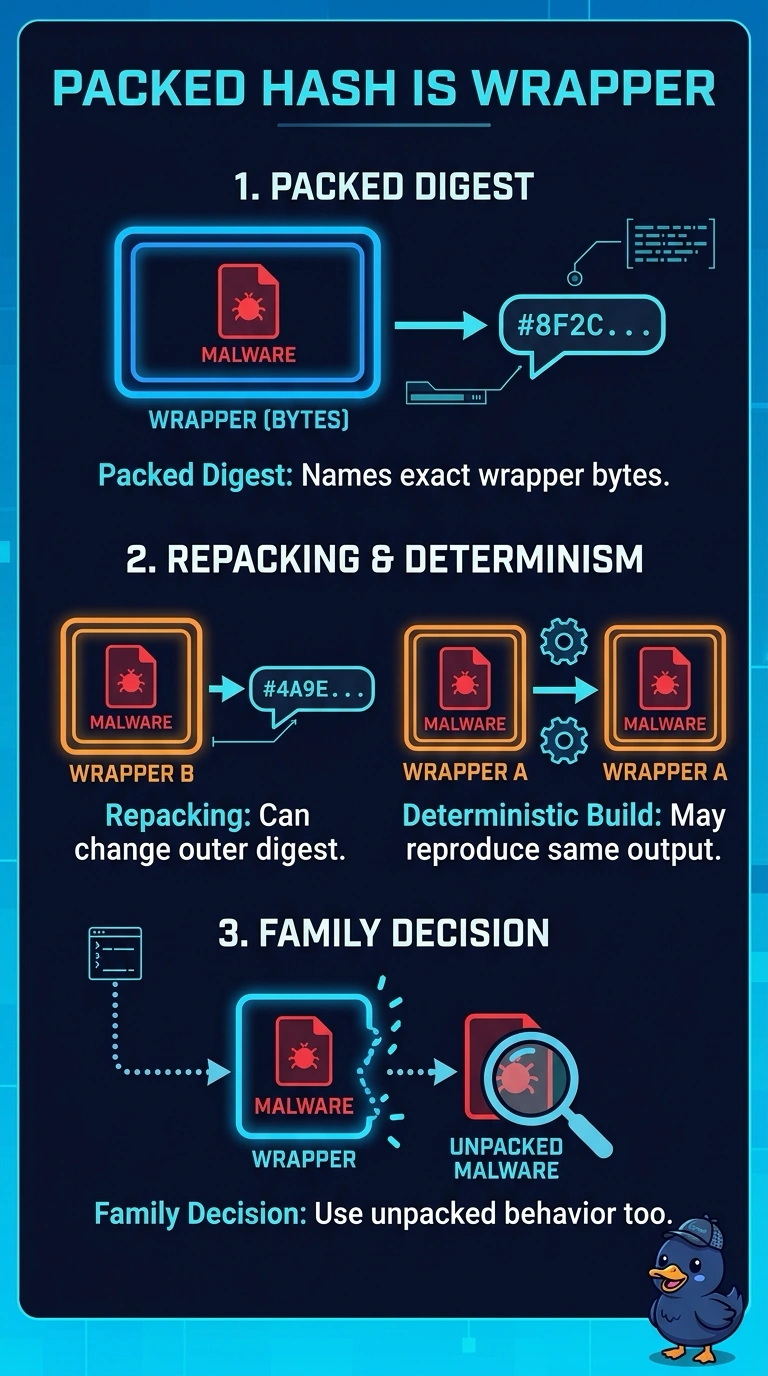
Short Explanation
A packed hash is a luggage tag, not the traveler name — you are naming one wrapper. Repacking can change the hash, but identical deterministic packing can reproduce the same output. A shared family hash, ignoring unpacked behavior, or calling packing encryption overstates what that digest means.
Full Explanation
A hash of the packed file identifies only this packed wrapper, so it is weak as a family name. Repacking can change the hash, but identical deterministic packing can reproduce the same output. That means packing variants can change the outer digest without changing the malware family, so the same activity can appear under different outer digests while identical builds may match. Family members do not share one packed hash as a reliable family name, because different packing variants, settings, or builds produce different outer byte sequences for the same payload and behavior. Unpacked behavior should not be set aside in favor of only the on-disk bytes, because those on-disk bytes describe the wrapper rather than the executed payload that defines family activity. Packing may use compression, encryption, or both; a packed-file digest is not a stable family identifier. Exam caveat: a packed hash remains useful as a sighting of that exact build, but it is a poor label for the family across builds. Operational check: Compare hashes across known packing variants; do not assume a second identical packing must differ.