
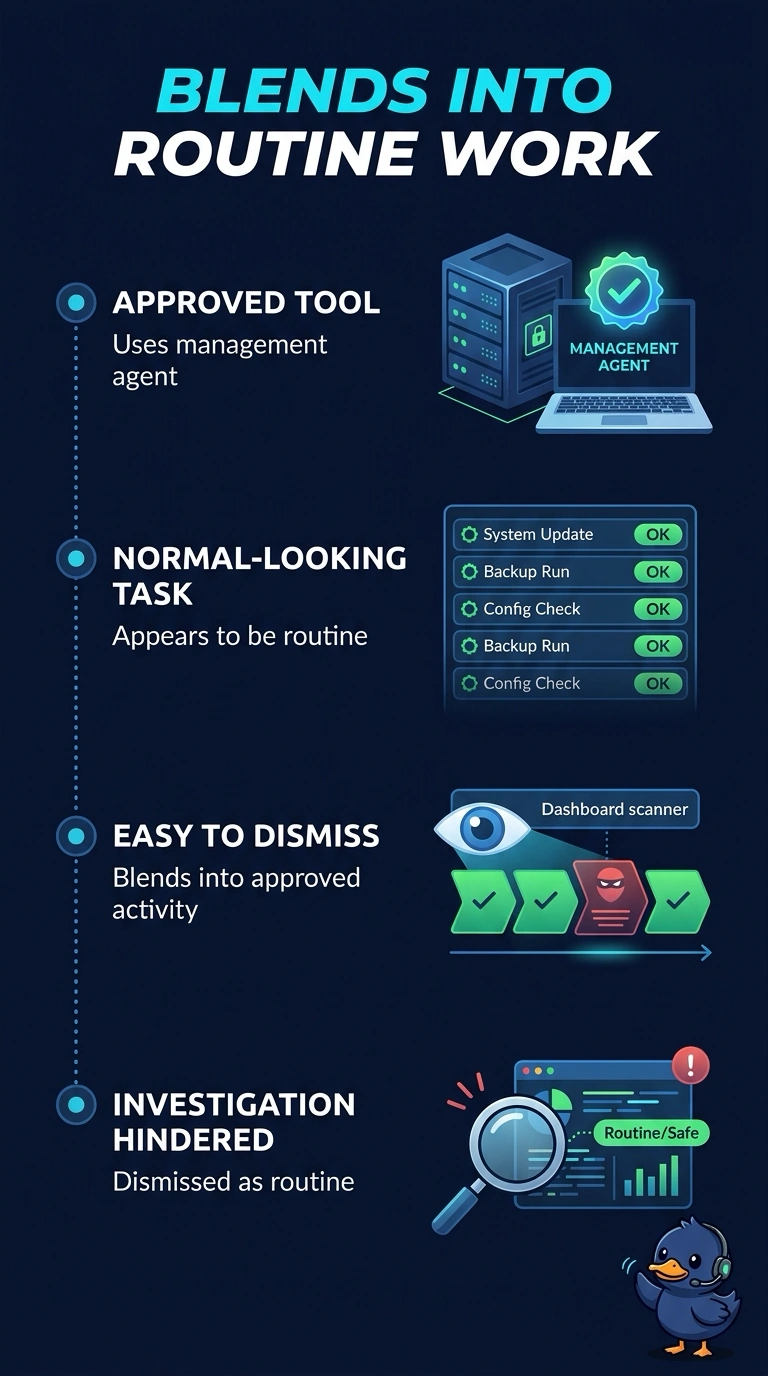
Malware on a software-company laptop was launched through the approved remote-management agent as a normal-looking task. Why does that choice hinder the investigation even though a process record exists?
Select an answer to reveal the explanation.
Short Explanation
The attacker borrowed the company master key instead of breaking a window. You still have a process, but it blends into the approved remote-management tool, so it is easy to dismiss as routine work. That choice is not encrypted history, a cleared Security log, or proof the payload was packed.
Full Explanation
The hindrance is camouflage. The task blends into an approved management tool, so it is easy to dismiss as routine work even though a process record exists. Analysts expect the remote-management agent to run tasks, and a normal-looking task hides among those approved jobs. The remote agent does not, by this fact pattern, encrypt its task history, and the stem already establishes that a process record can be reviewed afterward. A normal-looking task does not mean the malware cleared the Security log at the moment it started; log clearing is a separate anti-forensic act and is not implied by a legitimate parent. Launching through the management agent does not prove the payload was packed, and it does not mean its hash will not match; packing is about the file wrapper, while this choice is about blending into an admin tool. Exam caveat: blended admin tools still leave a process, a parent, and a task name, and the difficulty is recognition rather than absence. Operational check: compare the task command line and parent with the approved remote-management jobs, and flag any task the management team did not schedule.