
Rows parsed from a retail proxy export and a Secure Endpoint export use different timestamp formats. What must the script normalize before the combined timeline is trustworthy?
Select an answer to reveal the explanation.
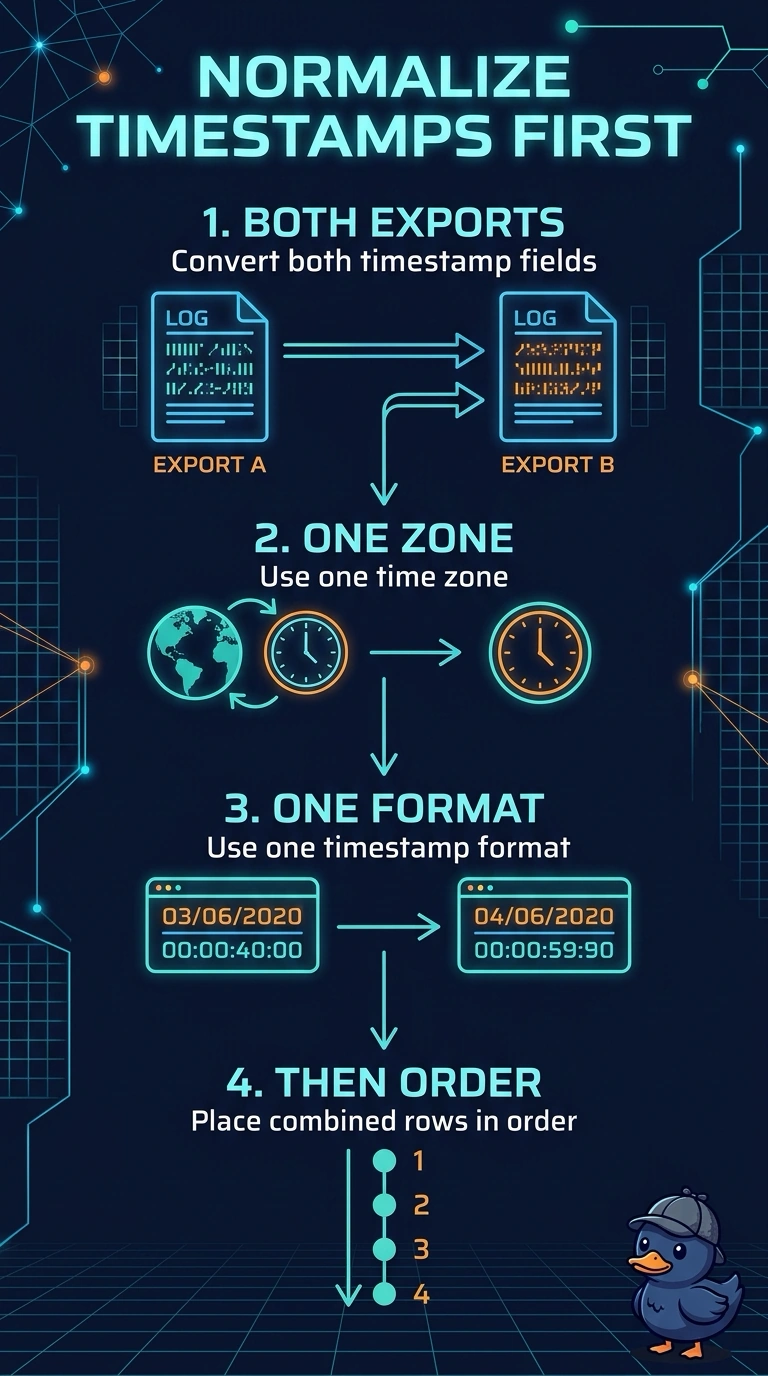
Short Explanation
Two clocks, one on a different face and one set to another zone, will not sort into a true sequence until you set them the same way. You normalize both timestamp fields to one zone and one format before the timeline is ordered. The trap is hashing the raw strings or trusting a spreadsheet import to align them.
Full Explanation
A timeline is only as honest as its clock. Convert both timestamp fields to one zone and one format before the combined rows are placed in order, or a string sort will interleave events that did not happen in that sequence. One export might use a zoned stamp and the other a different layout, so the script has to parse both and emit one comparable value. Discarding both timestamp fields and sorting the merged rows by the source filename instead of event time builds a file order, not a timeline. Hashing each raw timestamp string and treating equal hashes as proof that the events occurred at the same moment only detects identical text. Different formats for the same moment will not hash the same, and equal strings are not the goal of ordering. Leaving both original formats untouched and trusting a spreadsheet import to line the two clocks up hopes the import guesses both layouts and both zones. That guess is not a normalization step the analyst can defend. Exam caveat: even a shared zone is wrong if one source records local time and the other records UTC without a label, so the script should record which zone each source used. Operational check: print one raw stamp from each export, the single normalized value for each, and the sorted order that results.