
A logistics analyst opens a rule whose sections are meta, strings, and condition, and the rule names a byte pattern. What kind of rule is it?
Select an answer to reveal the explanation.
Short Explanation
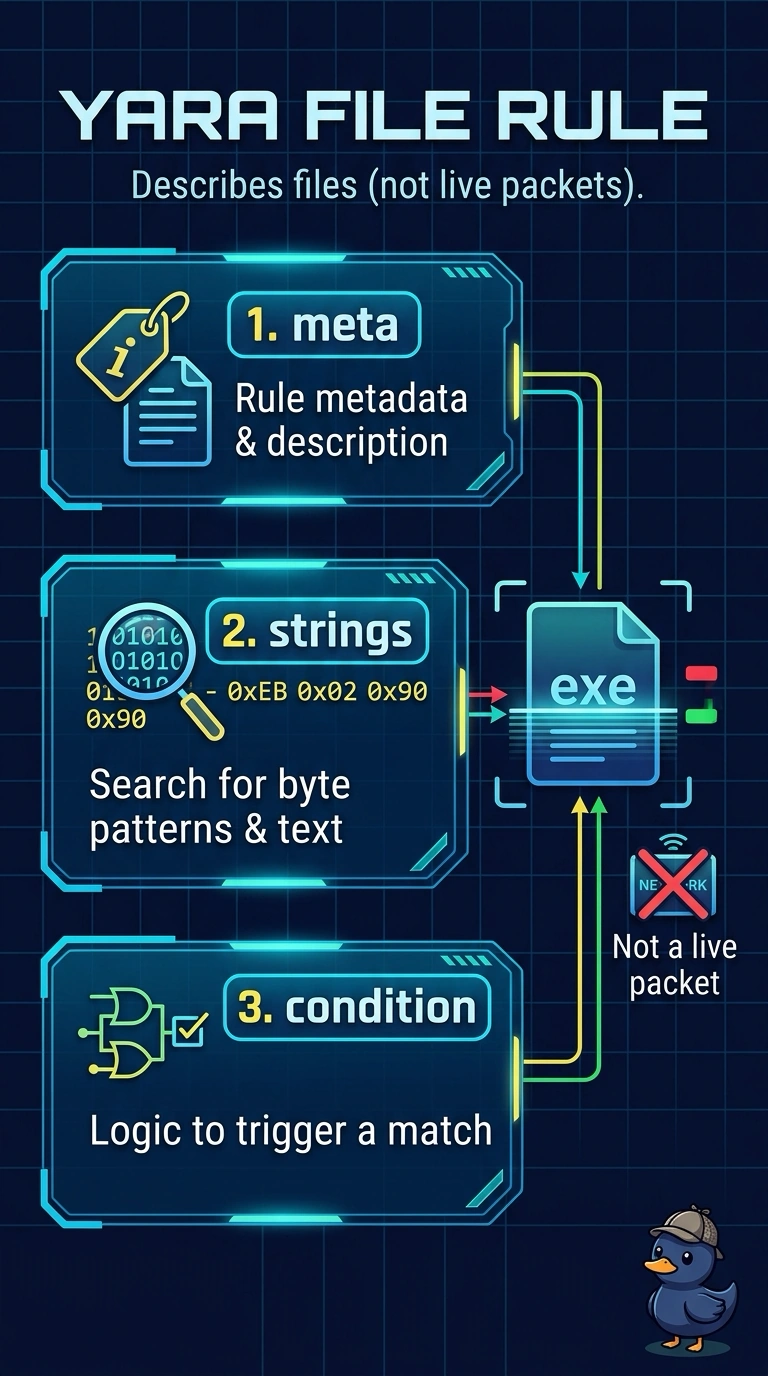
You are holding a file description card with notes, clues, and a test at the bottom. Those meta, strings, and condition sections mean the rule is YARA, not a Snort packet signature. STIX and a shell script do not use that three-part shape to describe a file.
Full Explanation
A YARA rule is organized into meta, strings, and condition sections, and that is exactly the shape in front of the analyst. Meta holds notes, strings holds the text or byte pattern, and condition says when the match counts, so the rule describes a file rather than a live packet. A Snort rule that treats meta, strings, and condition as fields in its packet header is misreading the syntax: a Snort rule starts with an action and a header of protocol and addresses, then options in parentheses, and it does not use those three section names. A STIX pattern that stores meta, strings, and condition as separate indicator objects confuses a data model with a file rule; STIX describes objects such as an indicator or malware, and TAXII would transport them, but neither is this rule text. A Bash script that defines meta, strings, and condition as ordinary shell variables would be assignments in a shell file, not a malware-description rule with a condition over a byte pattern. Exam caveat: a YARA match means the file fit the pattern, not that a process executed the file, and a very broad string can hit benign files. Operational check: confirm the rule text contains meta, strings, and condition, then test it on one known lab file and one known clean file before any wide hunt.