
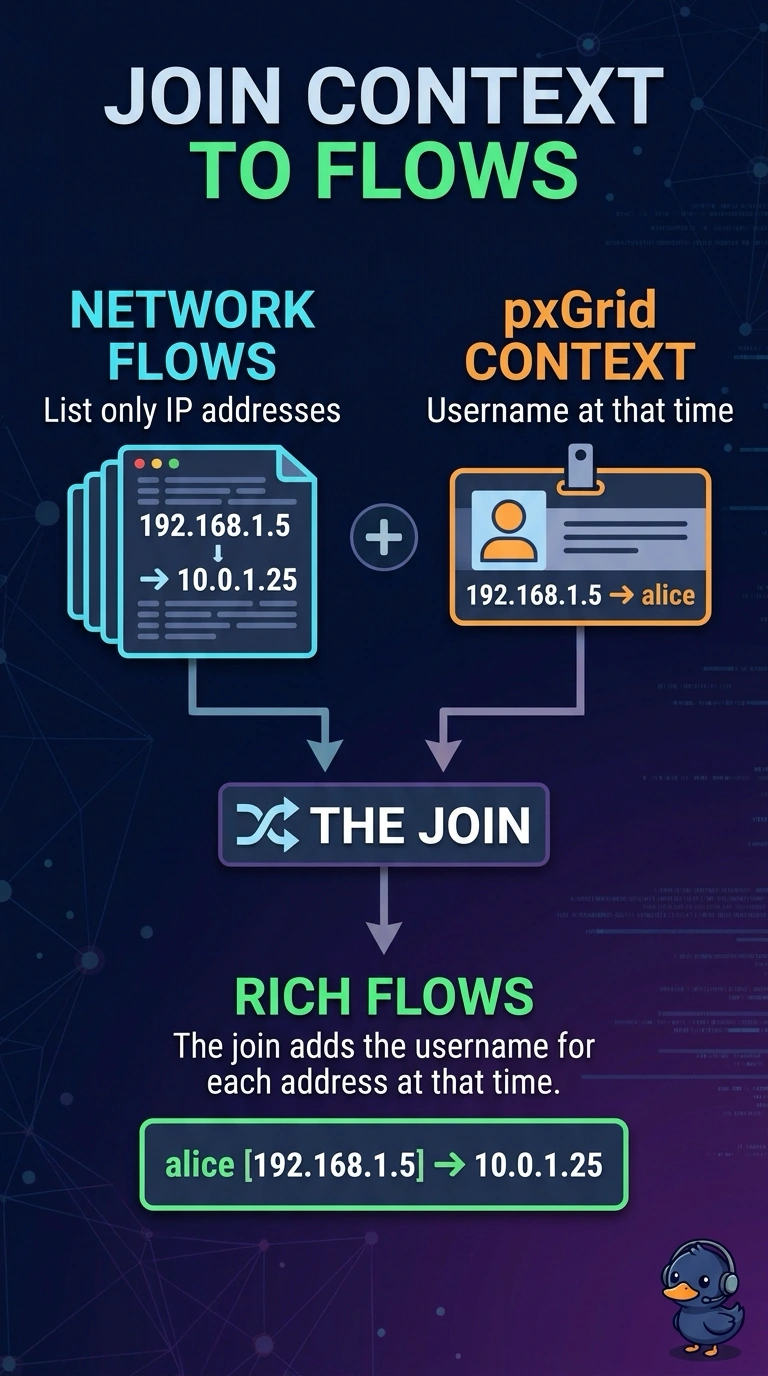
A retail investigation has pxGrid context naming the user for an IP at a given time, plus flow records that contain only addresses. What does joining those two sources accomplish?
Select an answer to reveal the explanation.
Short Explanation
Think of stapling a visitor log onto a stack of phone bills so you can label calls that showed only numbers. The join attaches the account/session identity associated with an IP and time; it does not prove which human or process generated the traffic. You avoid the trap of thinking it decrypts payloads or proves malware execution.
Full Explanation
Flow records in this export name addresses, not people. pxGrid context supplies account/session context for who held an address during a time window. The join attaches the account/session identity associated with an IP and time; it does not prove which human or process generated the traffic. That enrichment lets you read a flow as associated with an account/session at that timestamp instead of a bare IP, which is what the correct answer describes. The decryption idea fails by concept because neither source contains payload bytes, so no join can decrypt a flow payload or make a session URL path readable in script output. The blocking idea fails by concept because enrichment is not enforcement; turning every identity into a permanent block confuses context with a block decision, and a shared or reassigned address is a weak block by itself. The malware-proof idea fails by concept because sharing an address shows association at a time, not what was run; correlation across sources is not proof that the named account executed malware. Exam caveat: network address translation and short address leases can attach the wrong account/session identity if the time window is loose. Operational check: pick one flow, show the pxGrid session covering that address at that timestamp, and show the account/session identity the script attached.