
A scripted frame from a clinic workstation calls FromBase64String and then Invoke-Expression. After the hidden block is decoded, why is the payload still treated as PowerShell?
Select an answer to reveal the explanation.
Short Explanation
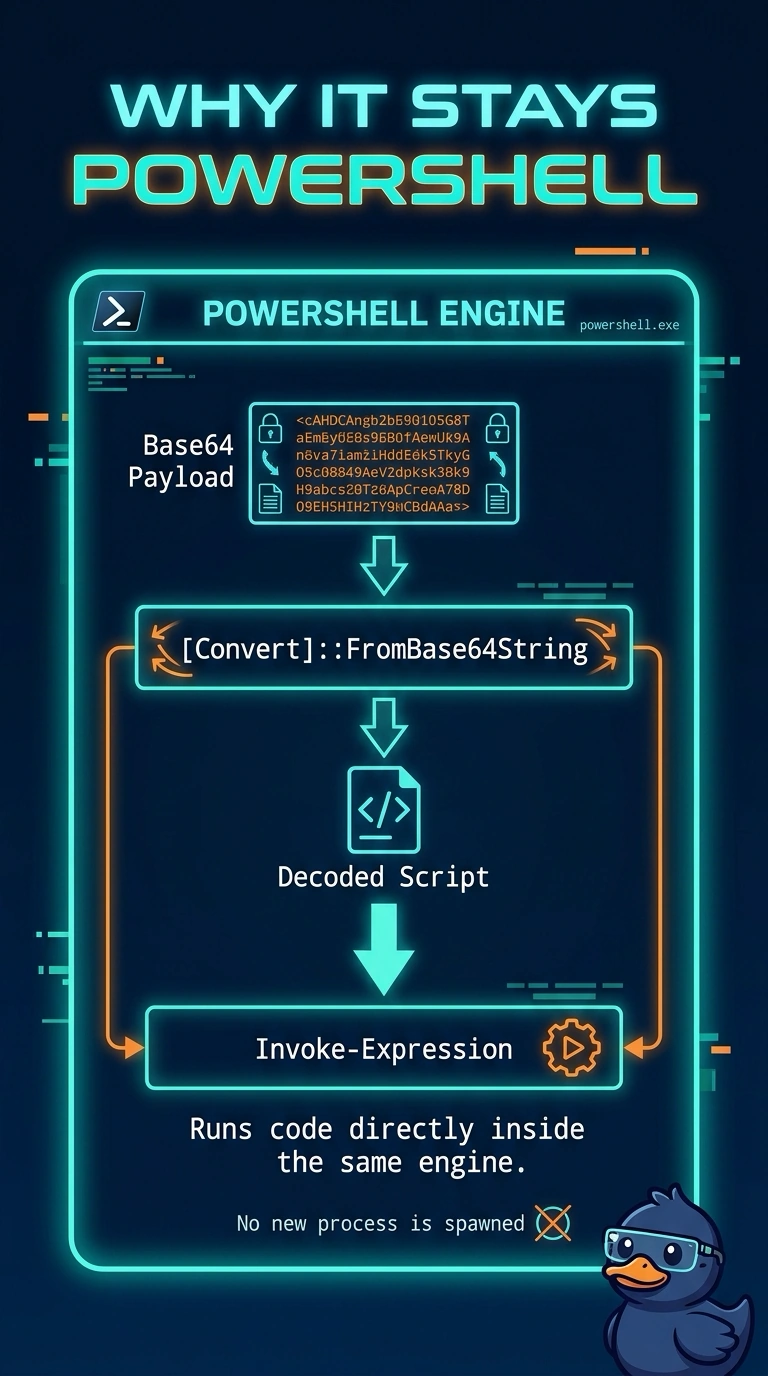
Base64 is a costume, not a new language. You turn the decoded bytes back into a string and Invoke-Expression still runs that string inside the same PowerShell engine. Don't let the hiding trick you into seeing shellcode, C#, or Python.
Full Explanation
FromBase64String returns decoded bytes; an appropriate text-decoding step converts them to a string before Invoke-Expression evaluates that string as PowerShell. So the payload is still PowerShell even though the characters were hidden. Base64 does not translate a script into another language, and the outer frame never handed the bytes to a different runtime. The decoded block does not become raw shellcode merely because it was encoded, and the outer frame still matters because Invoke-Expression is what executes the restored string. FromBase64String is a .NET method commonly called from PowerShell, but calling it does not switch the script into compiled C# or leave PowerShell behind. Invoke-Expression does not start a new Python interpreter for the hidden text; it parses PowerShell. Exam caveat: if the decoded string itself launches another program, that child is a later stage, and the stage you are reading is still the PowerShell engine. Operational check: decode the block in an isolated session and read the restored string for PowerShell cmdlets before you allow Invoke-Expression to run it.