
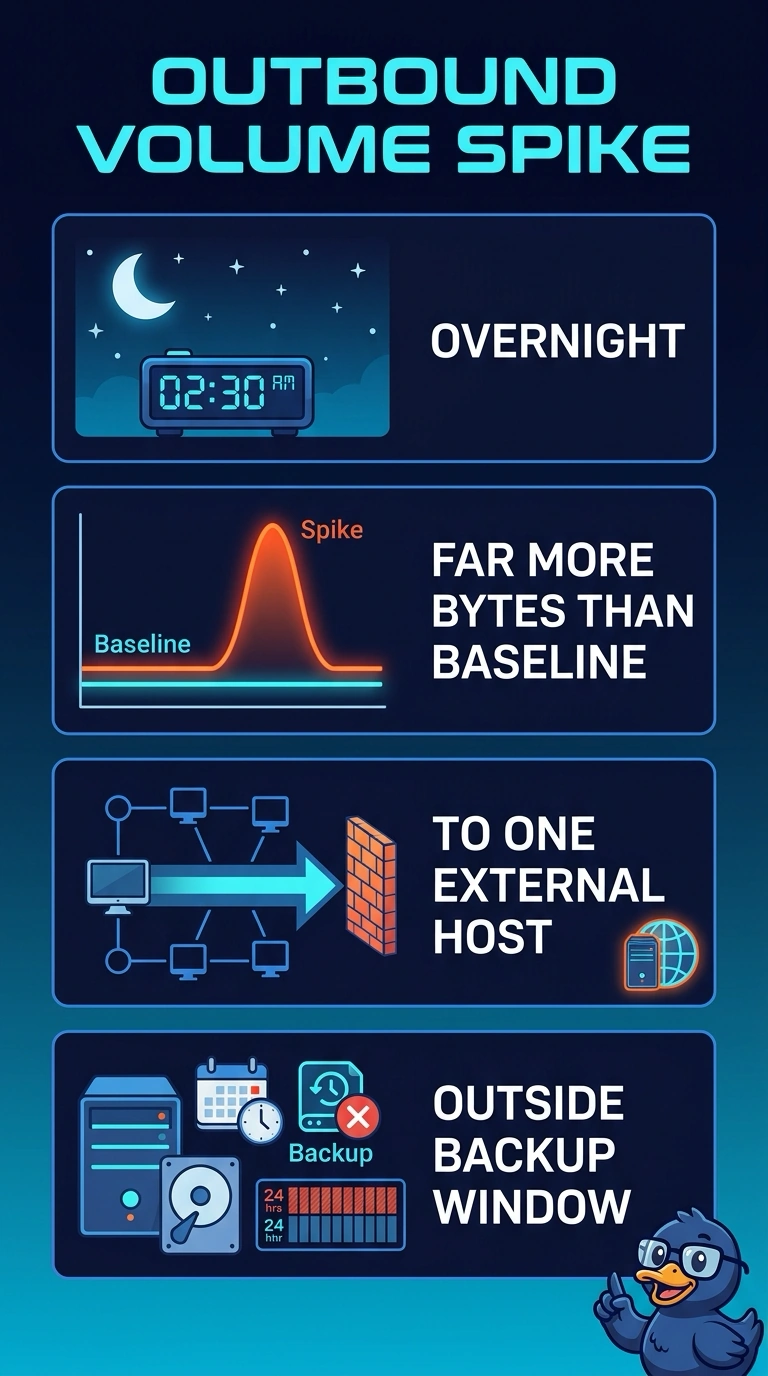
Overnight, a school file server sends far more bytes than its baseline to one external host, and the transfer sits outside any backup window. Which anomaly does that pattern show?
Select an answer to reveal the explanation.
Short Explanation
Picture a loading dock that usually ships one pallet and then rolls out a full truck overnight. You are looking at an outbound volume spike to an external host outside the backup window, and that volume shift is the anomaly. Beaconing, a port scan, and a DNS tunnel are different shapes than the one on this server.
Full Explanation
The observation is a byte count far above the file server's baseline, aimed at one external host, with no matching backup window. That is an outbound volume spike, and the missing window matters because a scheduled backup would have been the benign explanation for a large transfer. Regular beaconing is many short connections on a steady repeating timer, not one bulky transfer. A horizontal scan probes the same service or port across many hosts. Nothing here describes that spread across hosts. A DNS tunnel would show encoded queries carrying contents through the name system, which this report does not mention. Volume is the anomaly class that fits the byte count, the single external host, and the absent backup window. Naming it beaconing, a scan, or a tunnel would send the next collection after timers, port spreads, or query names instead of the byte counter and the backup calendar. Exam caveat: a volume spike is a lead for exfiltration or misuse, not by itself a completed proof of what the bytes were. Operational check: compare the host pair and byte totals with the server's baseline and with the backup schedule before you name the activity.