
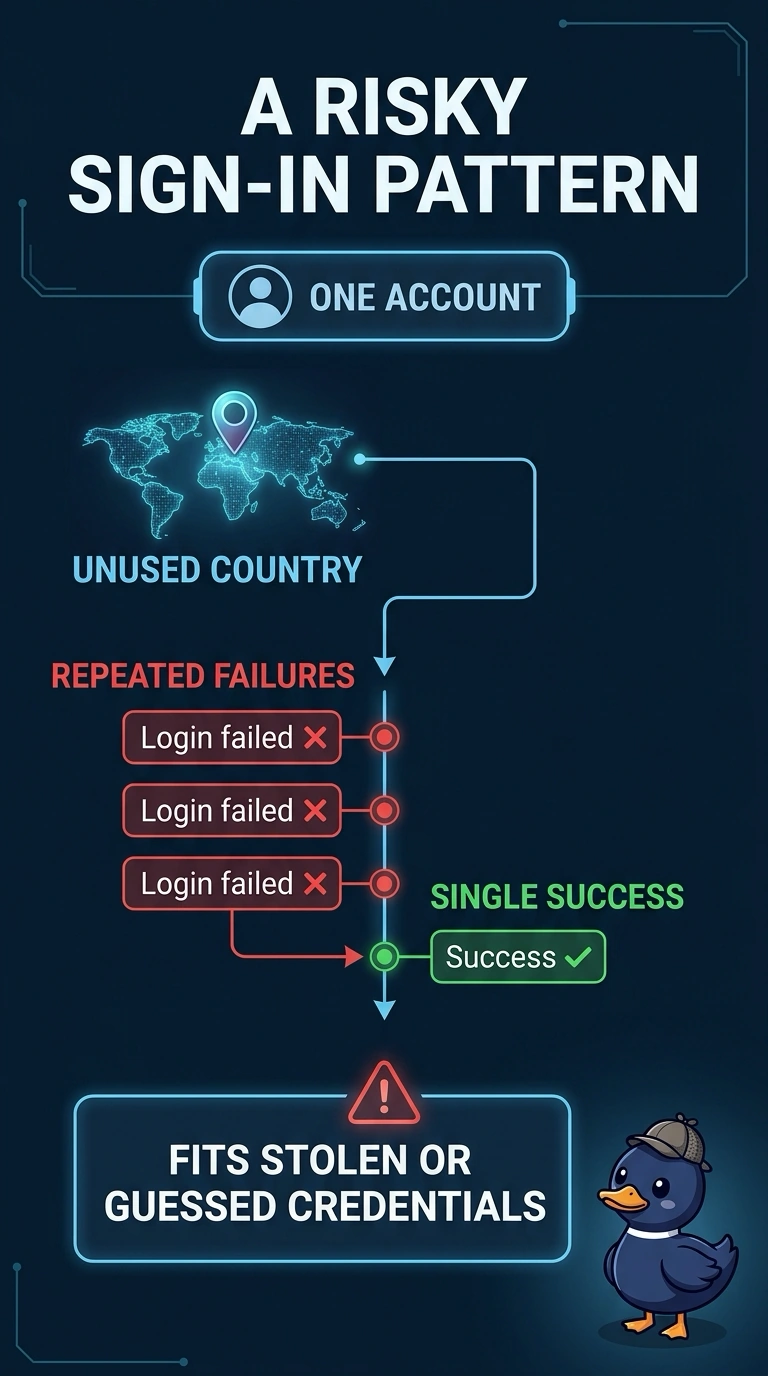
Identity logs at a clinic show many failed sign-ins for one account and then a single success, all from a country that account has not used before. What conclusion does that sequence support?
Select an answer to reveal the explanation.
Short Explanation
A string of failures and then one success from a country this account does not use is a lock that finally clicked for the wrong person. You treat that success as fitting a stolen credential, not as a surprise vacation. The failures do not erase the success, and the log is not an empty gap.
Full Explanation
The sequence is many failures followed by one success from a country the account has not used. That pattern supports a conclusion that the success after repeated failures from an unused country fits a stolen or guessed credential. The failed attempts do not cancel the success, and the account should not be treated as still uncompromised merely because earlier tries failed. The country value does not prove the person traveled, so the successful sign-in should not be treated as expected without corroboration; geography is a clue, not a travel record. The sequence does not show only a logging gap, because both the failures and the success were written, so an authentication attempt did occur. Exam caveat: a VPN exit can produce an unfamiliar country, so the pattern supports compromise as the working conclusion and still needs the MFA result and the user's known activity. Operational check: open the success event, note the source country and the preceding failures, and compare them with the account's prior countries and whether MFA completed.