
The strings utility prints no URL from a sample the team already knows is encoded. Why does that clean pass fail to clear the file?
Select an answer to reveal the explanation.
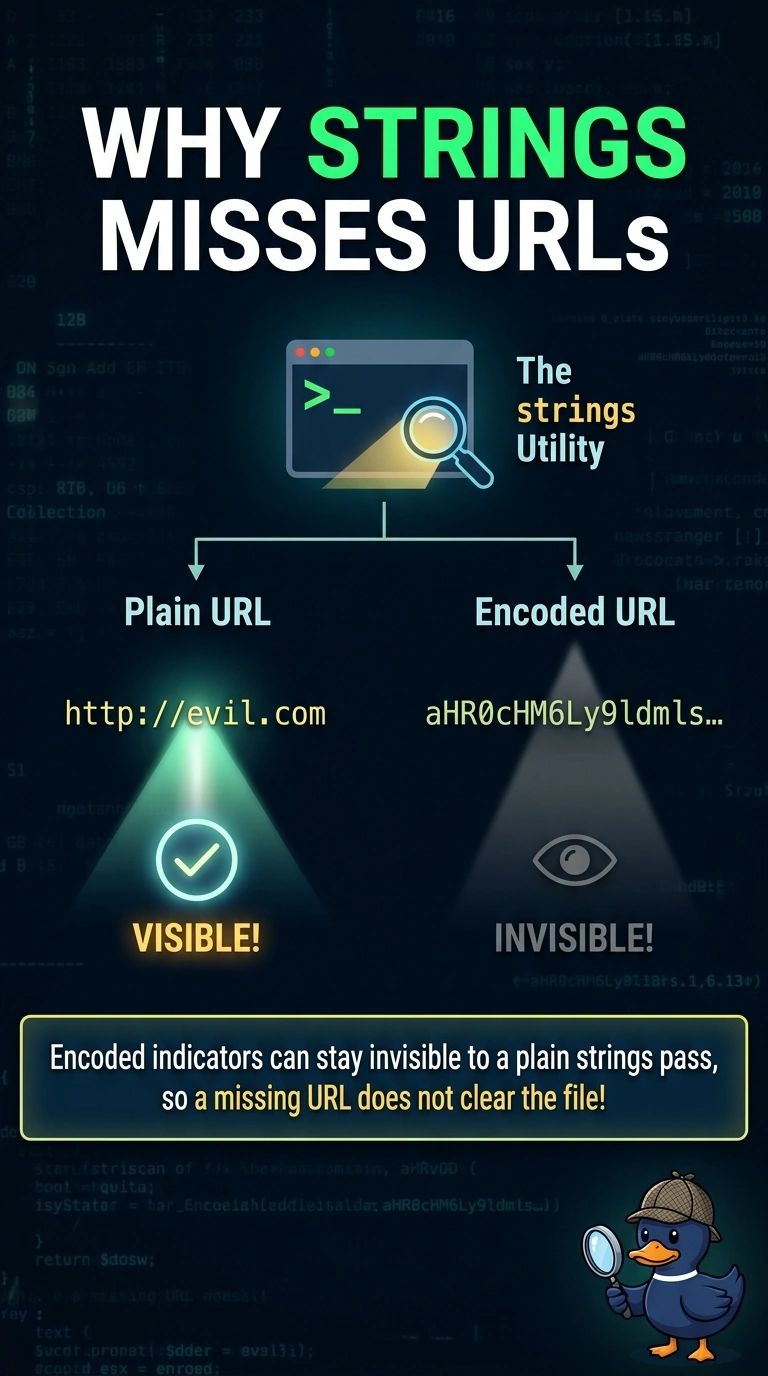
Short Explanation
strings is a magnet for loose metal, and encoded text is metal wrapped in cloth. You can miss a URL completely when the sample is encoded, so a clean pass does not clear the file. Treating Base64 as encryption, or running strings again, does not create the missing address.
Full Explanation
The strings utility prints contiguous readable characters. Encoded indicators can stay invisible to a plain strings pass, so a missing URL does not clear the file: Base64, hex, or XOR can hold a URL that never appears as plain text. A clean pass only shows that the obvious readable form was absent. A second strings pass with a shorter readable run will not recreate any hidden URL, because lowering the minimum length still does not decode the bytes. Base64 is not encryption, and a missing URL does not prove no cipher text is present; Base64 and hex are encodings, and the sample can still carry an encoded address. The sample is not harmless once strings fails to print a readable web address, because that failure is expected when the author encoded the text. Exam caveat: a strings hit on a URL is a lead, and the absence of a hit is not a benign verdict. Operational check: identify the encoding, decode a copy, and run strings again on the decoded bytes before you write that the sample has no network indicator. If a URL appears only after decoding, attach both the decoded text and the original hash to the ticket.