
Endpoint detection on a branch PC was stopped shortly before a suspicious file copy, and the console is silent for that window. How should the analyst treat the telemetry gap?
Select an answer to reveal the explanation.
Short Explanation
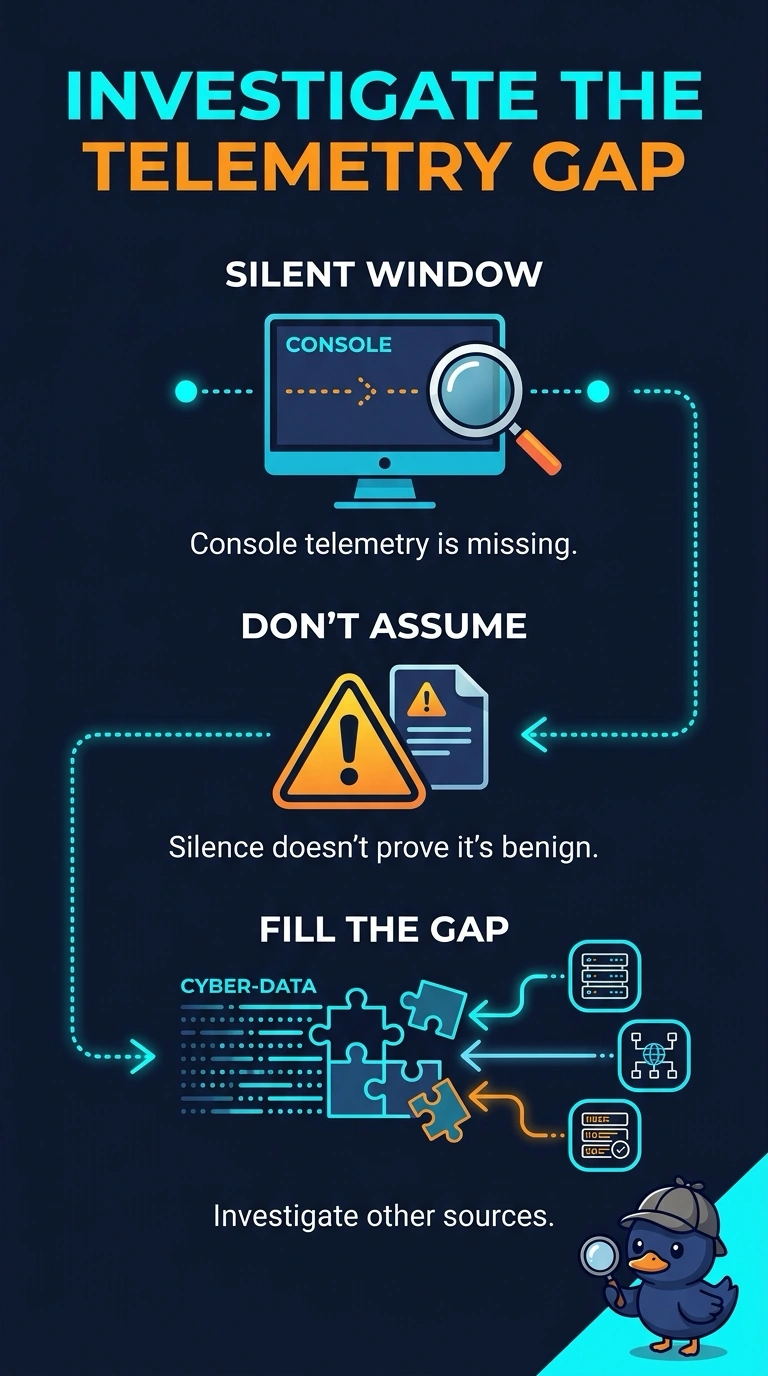
A camera with the lens cap on does not prove the room was empty. You treat the silent window as a gap and fill it from disk and network records that do not depend on the stopped agent. An empty alert list is a missing sensor, not a clean bill of health for the copy.
Full Explanation
When the endpoint agent stops, its console cannot speak for that interval, and silence is not a finding of innocence. Treat the silent window as a gap to fill from other sources, not as proof the copy was benign; filesystem changes, authentication logs, and network records can still describe the copy. Accept the empty alert list as proof the copy was benign, on the belief the product would have reported any problem, and you treat a stopped sensor as if it had been watching. Build the timeline from the missing alerts alone and set aside disk and network records for that window and the story stays empty on purpose. Close the case on the view that a stopped agent means the host had no activity worth keeping and a telemetry failure becomes a false all-clear. The stop itself is a lead, whether from tampering, a crash, or maintenance, but it does not answer what the copy was. Exam caveat: an agent can stop for an upgrade, so note any logged reason, and still fill the window from sources that do not depend on that agent. Operational check: mark the time the agent stopped, then review file changes and network records for that window from systems other than the stopped agent.