
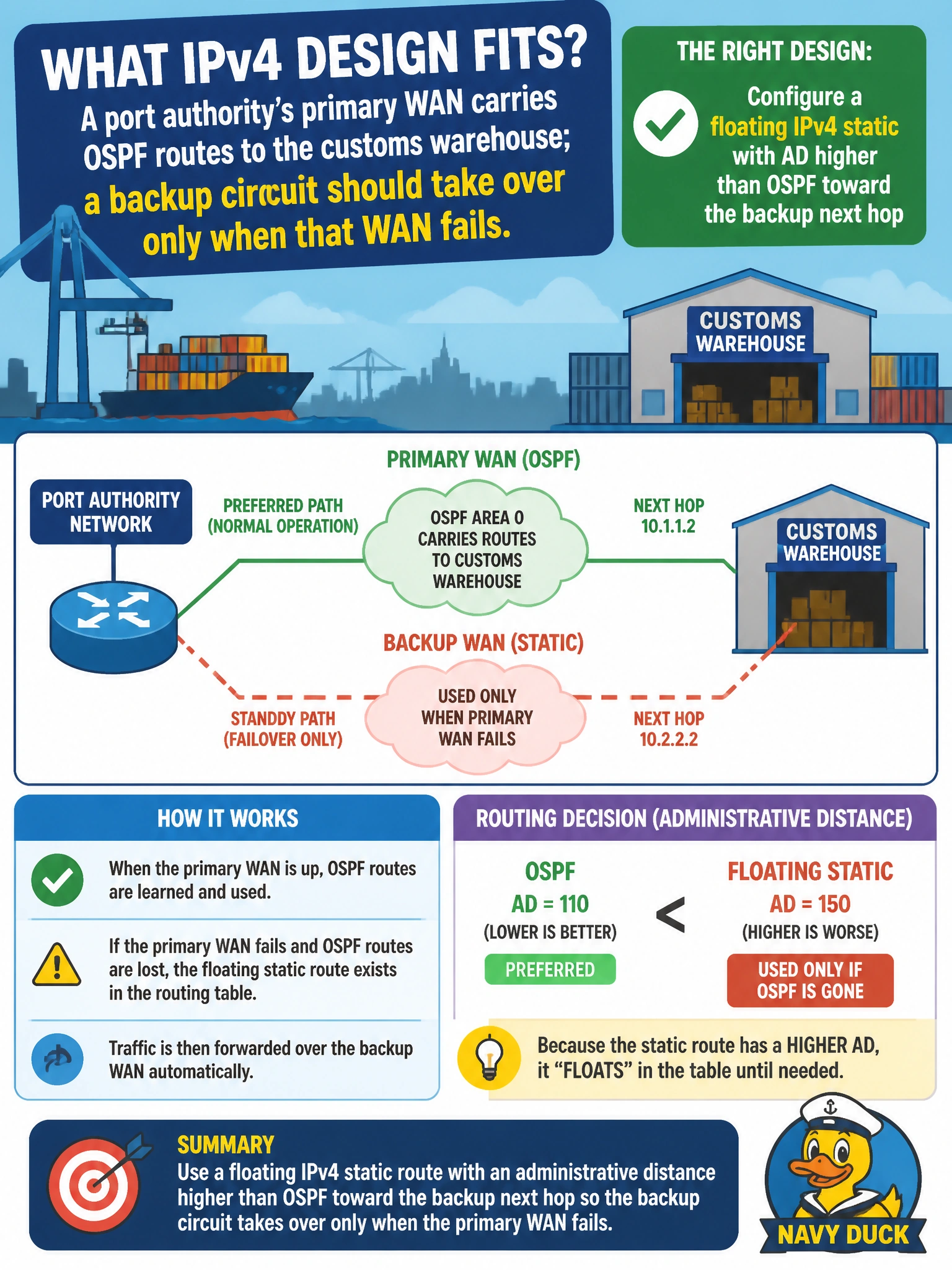
A port authority’s primary WAN carries OSPF routes to the customs warehouse; a backup circuit should take over only when that WAN fails. What IPv4 design fits?
Select an answer to reveal the explanation.
Short Explanation
Primary WAN is the front door; the floating static is the side door with a stickier lock (higher AD). Leave it worse than OSPF so it only opens when the front door fails.
Full Explanation
The port authority wants OSPF-learned paths over the primary WAN to remain preferred to the customs warehouse, with a backup circuit used only after that WAN fails. That is classic floating-static design: configure an IPv4 static toward the backup next hop with an administrative distance higher than OSPF (higher than 110 for standard OSPF routes). While the primary WAN advertises the warehouse prefix via OSPF, the static stays out of the RIB; when OSPF withdraws the route, the higher-AD static installs and forwarding shifts to the backup circuit.
Installing a static with AD 1 permanently replaces OSPF and defeats the “backup only” requirement. Disabling IP routing until a ticket is opened is not an automatic failover mechanism and breaks dynamic recovery. Setting both paths to AD 110 and hoping ECMP “always prefers backup” misunderstands equal-cost behavior: identical AD with equal metrics can load-share or pick unpredictably; it does not encode primary/backup preference.
Exam caveat: floating statics protect against loss of the dynamic route entry, not necessarily against a blackhole where OSPF remains up but the path is unusable—use tracking/IP SLA if the exam scenario demands that sophistication. Operational check: with primary up, show that the warehouse prefix is OSPF-sourced; fail the primary WAN, confirm the floating static appears with the elevated AD via the backup next hop, and restore primary to watch OSPF reclaim the route.