
A municipal hospital campus router must reach a remote building’s IPv6 LAN prefix 2001:db8:44:10::/64. Which static is appropriate?
Select an answer to reveal the explanation.
Short Explanation
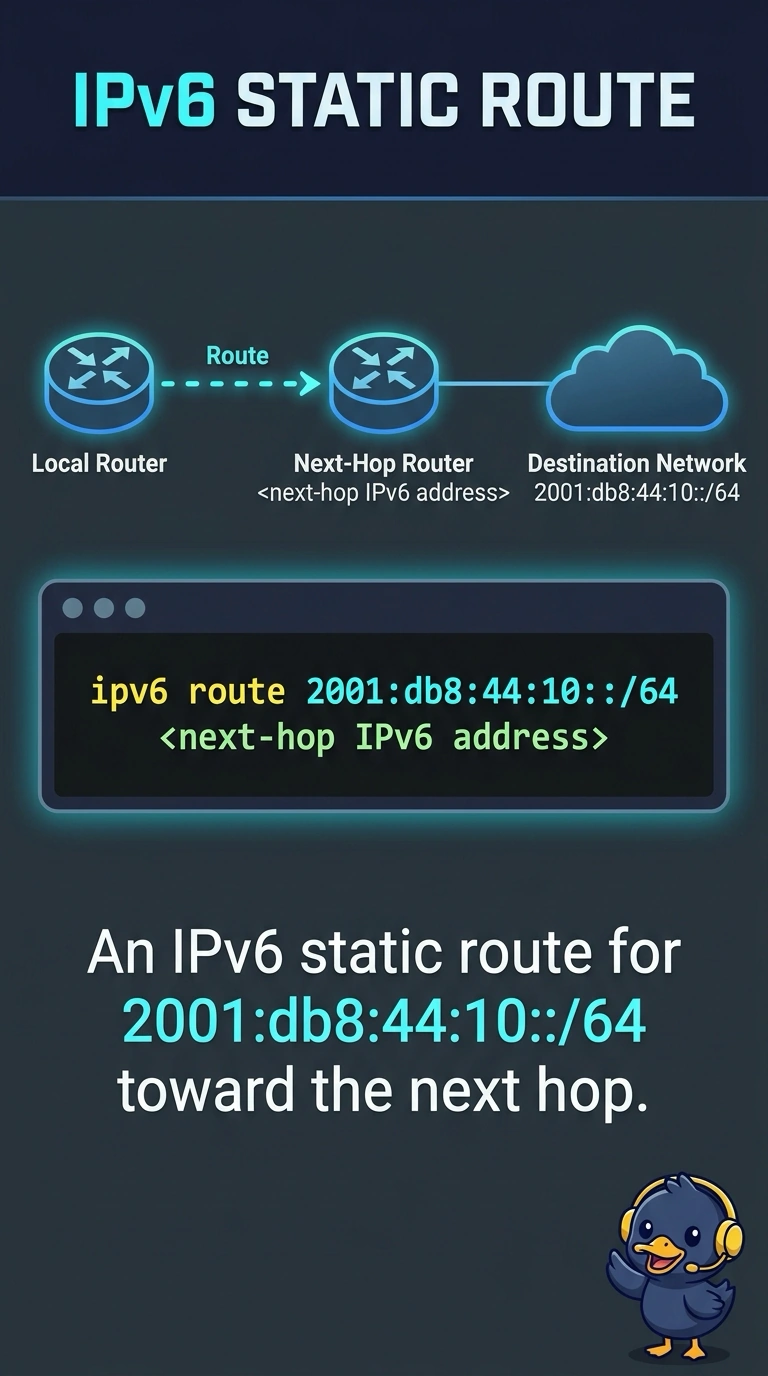
You can treat the remote wing as its own /64 neighborhood. Use an IPv6 network static for that prefix toward the building next hop, rather than sending all IPv6 traffic down a default or treating link-local space as a global LAN route.
Full Explanation
The remote building’s IPv6 LAN is the specific prefix 2001:db8:44:10::/64, so the appropriate static is an IPv6 network route for that /64 with a next hop toward the building. The next hop may be link-local on the interconnect interface or global, depending on the design. Longest-prefix match then directs packets for addresses in the building LAN through this route without changing the handling of unrelated IPv6 destinations that have their own routes or a separate default. An IPv4 host route to the building’s NAT address does not provide IPv6 forwarding for 2001:db8:44:10::/64. An IPv6 default ::/0 that blackholes every other IPv6 destination on campus has far broader scope than one remote LAN and would disrupt unrelated traffic. A FE80::/10 summary advertised as a global route is also unsuitable: link-local space is not a substitute for the building’s globally routed /64 or a normal remote network route for campus user traffic. Exam caveat: match the static route’s prefix length to the remote LAN; /64 is typical for one LAN, while a site /48 summary should be used only when that is the intended scope. Practical check: verify the IPv6 RIB shows 2001:db8:44:10::/64 via the building next hop, ping an address in that prefix from campus, and confirm CEF/FIB forwarding uses the intended interface rather than relying on an accidental default.