
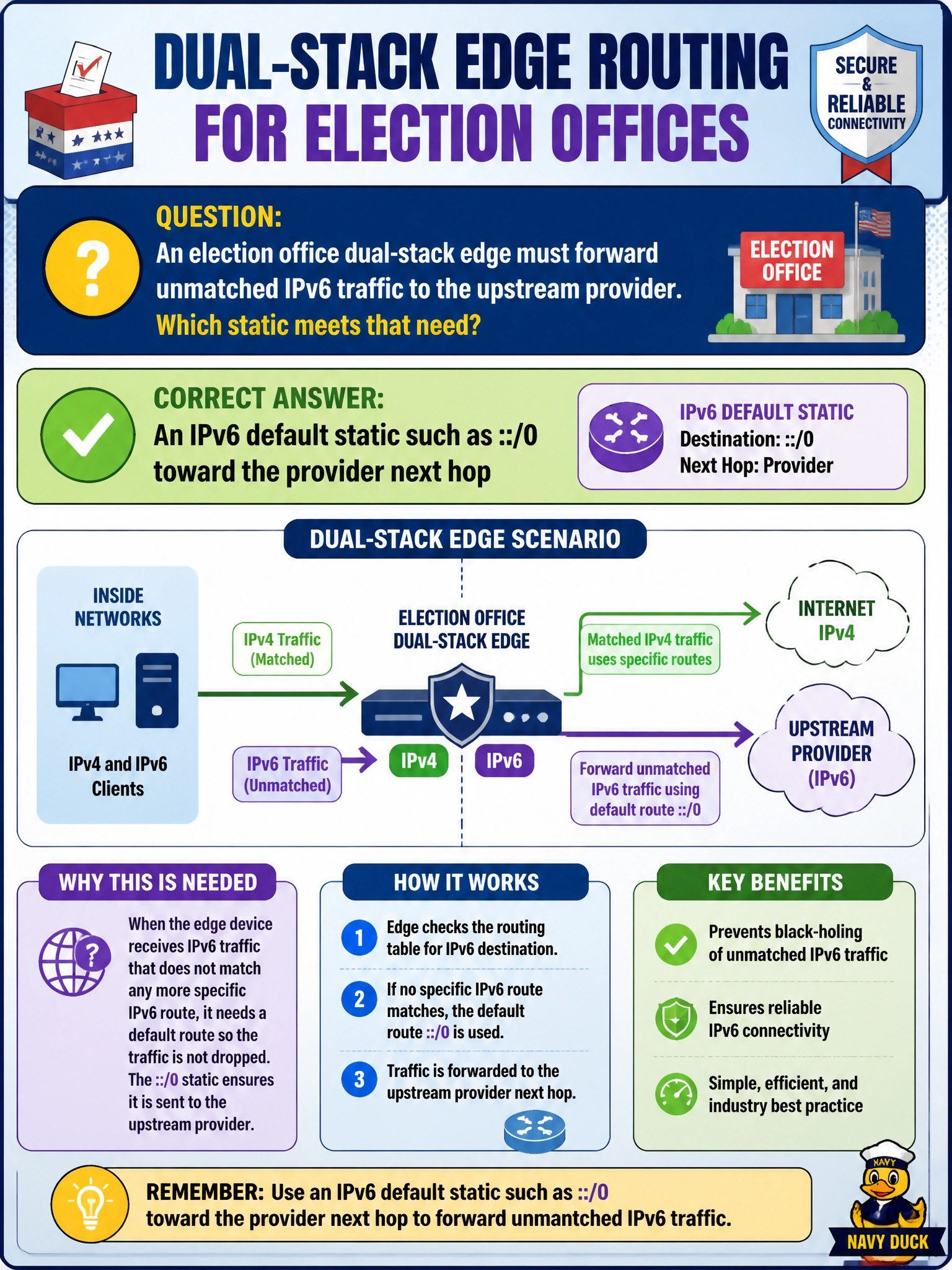
An election office dual-stack edge must forward unmatched IPv6 traffic to the upstream provider. Which static meets that need?
Select an answer to reveal the explanation.
Short Explanation
On a dual-stack edge, you need a separate IPv6 last-resort route; IPv4 will not automatically carry unmatched IPv6 traffic. Point ::/0 toward the provider’s IPv6 next hop, and you can send unmatched IPv6 traffic upstream.
Full Explanation
A dual-stack edge has separate IPv4 and IPv6 forwarding planes. To send unmatched IPv6 traffic upstream, configure an IPv6 default static, typically ::/0, toward the provider’s IPv6 next hop. This is the IPv6 equivalent of IPv4’s 0.0.0.0/0: more-specific routes, such as connected /64s, statics, or OSPFv3 routes, win by longest match, while traffic without a more-specific match uses the default. Without ::/0, unmatched IPv6 traffic is dropped even if IPv4 Internet access works. An IPv4-only default does not forward IPv6, and dual-stack does not automatically tunnel unknown IPv6 unicast traffic over IPv4. A link-local address alone identifies an on-link neighbor for NDP but does not install a default route covering the global unicast space. An OSPFv3 virtual link provides area connectivity in the OSPF topology; it does not create a provider default for unmatched user traffic. Exam caveat: IPv6 statics often require a global or link-local next hop on the correct interface; using only an Ethernet exit interface can lead to fragile address-resolution behavior. Remember that ::/0 is IPv6-specific. Practical check: inspect the IPv6 routing table for ::/0 via the provider next hop, then ping or traceroute an unmatched external IPv6 address from the edge and confirm traffic leaves toward the provider rather than failing for lack of a route.