
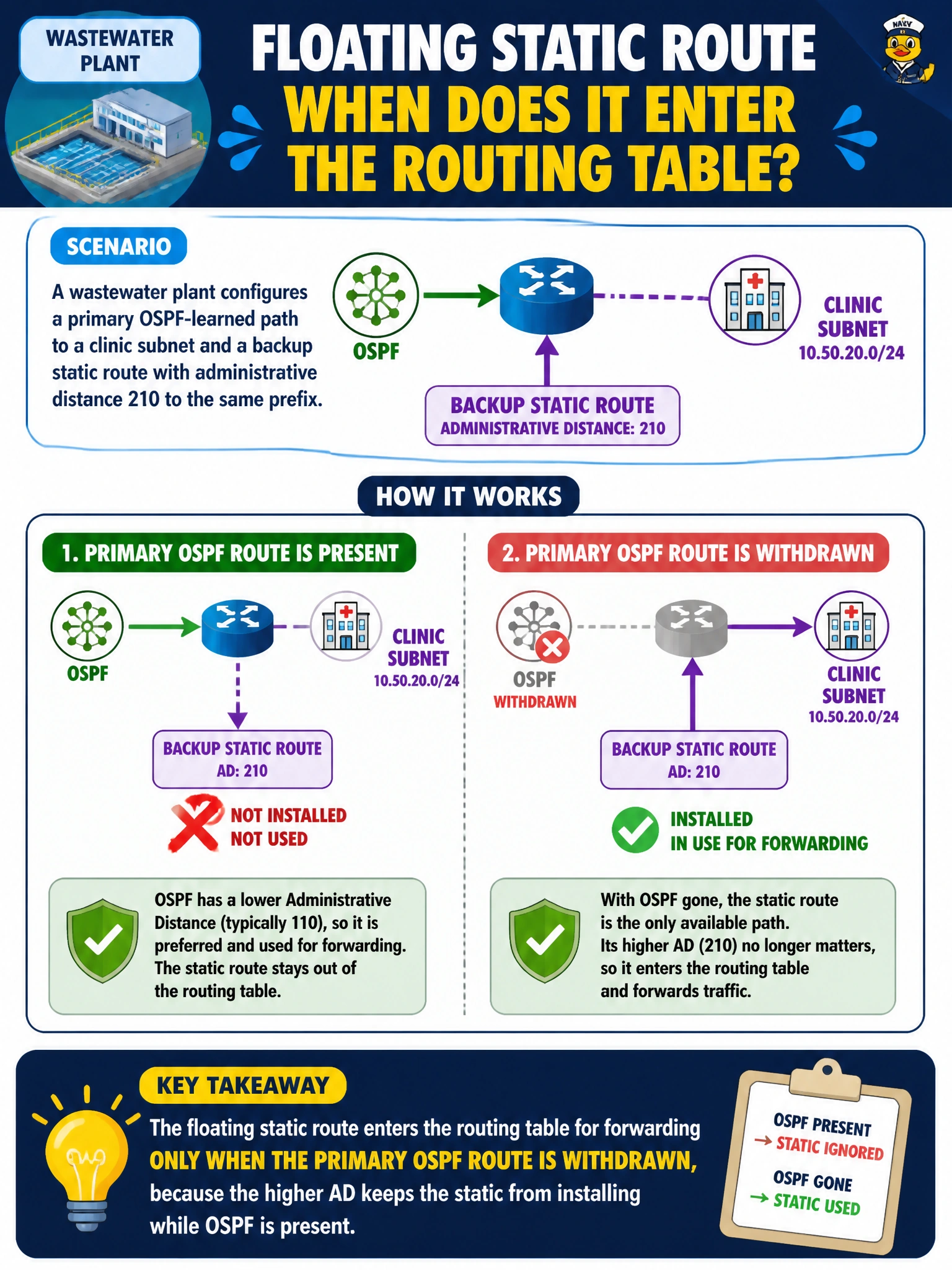
A wastewater plant configures a primary OSPF-learned path to a clinic subnet and a backup static route with administrative distance 210 to the same prefix. When does the floating static enter the routing table for forwarding?
Select an answer to reveal the explanation.
Short Explanation
A floating static is the spare tire with a higher AD—left in the trunk while OSPF is healthy. It only mounts when the primary route disappears; STP drama downstairs does not install it.
Full Explanation
A wastewater plant that prefers an OSPF-learned clinic path and configures a backup static with AD 210 is using a floating static. That static enters the routing table for forwarding only when the primary OSPF route is withdrawn, because the higher AD keeps it from installing while OSPF is present. This is the classic municipal WAN backup pattern: dynamic primary, higher-AD static standby.
Installing immediately alongside OSPF fails because a worse AD does not displace or co-install as the active RIB entry against a better source for the same prefix. Claiming static AD cannot exceed 1 fails because administrators routinely set AD above defaults for floating behavior. Tying installation only to Spanning Tree reconvergence fails because STP events do not control whether a floating static replaces an OSPF RIB entry.
Exam caveat: the floating static must use a next hop that remains valid when the primary fails; also confirm redistribution policies so the backup path does not create loops when it activates. Operational check: show ip route for the clinic prefix (OSPF installed, static absent or not preferred), withdraw/fail the OSPF path in a maintenance window, confirm the AD 210 static installs, and restore OSPF to verify the static returns to standby.