
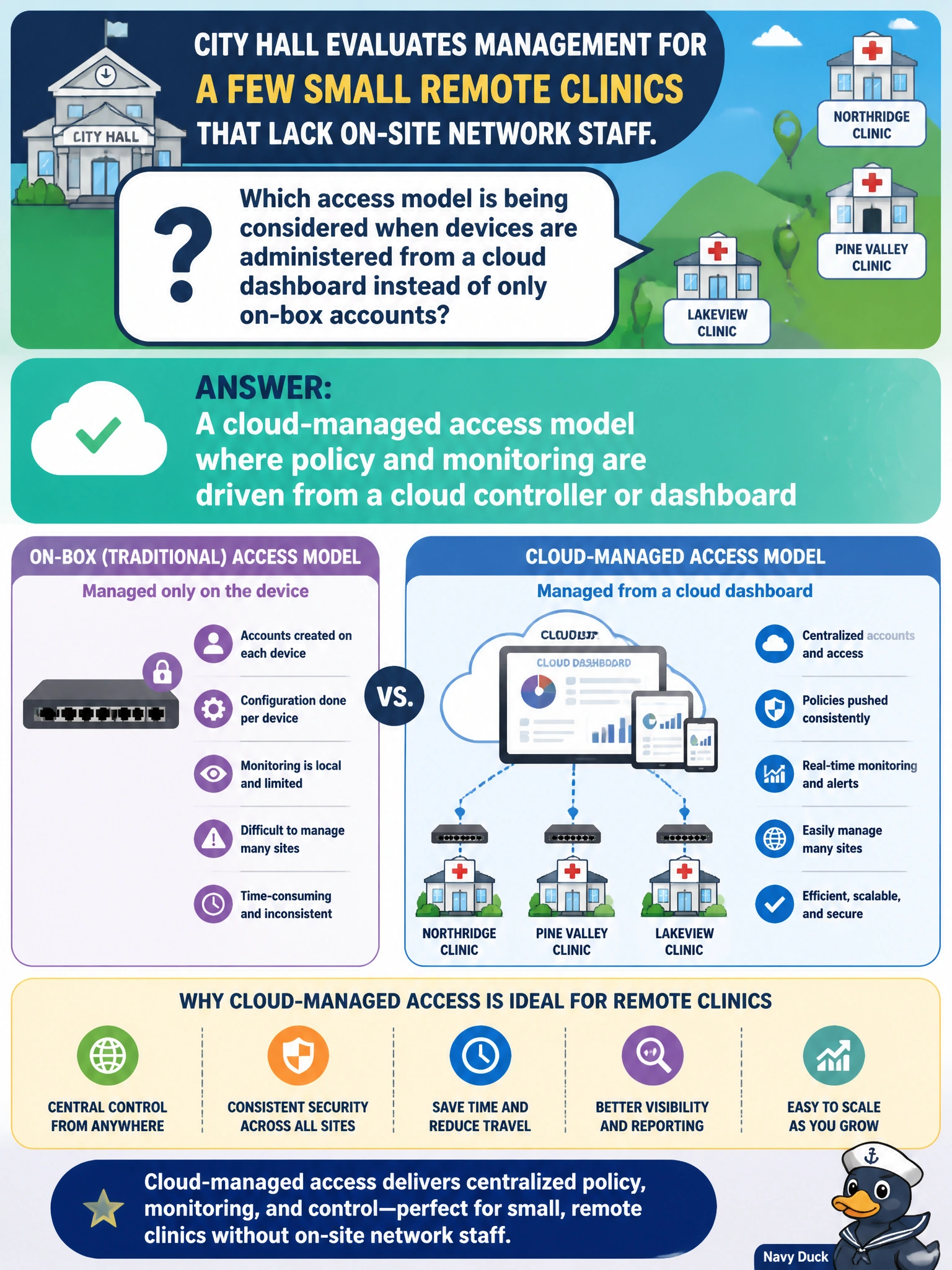
City hall evaluates management for a few small remote clinics that lack on-site network staff. Which access model is being considered when devices are administered from a cloud dashboard instead of only on-box accounts?
Select an answer to reveal the explanation.
Short Explanation
For tiny remote clinics without resident network staff, you can configure and monitor devices from one cloud dashboard instead of driving to each closet. That is the cloud-managed access model, at CCNA recognition depth.
Full Explanation
When city hall administers small remote clinics from a cloud dashboard rather than relying only on on-box accounts and per-device CLI, it is evaluating a cloud-managed access model. In this model, policy, monitoring, and often configuration templates are driven from a cloud controller or dashboard, which suits sites without resident network staff. Operators gain central visibility without having to log into each clinic device individually. Strictly console-only management with no remote path contradicts dashboard administration. Autonomous AP flash editing with no central visibility is the opposite of cloud-managed oversight. A serial modem-bank setup as the sole remote administration path is a legacy out-of-band approach, not cloud-managed access. Exam caveat: cloud-managed does not mean “no security” or “no local fallback”; devices still need reachability outbound to the cloud service. Identify the model by how administration and monitoring are delivered, not by buzzwords alone. Practical check: onboard a clinic trial device to the cloud dashboard, push a WLAN or switch policy from the cloud, confirm that the device applies it, and verify that monitoring and alerts appear centrally without logging into each clinic device over console.