
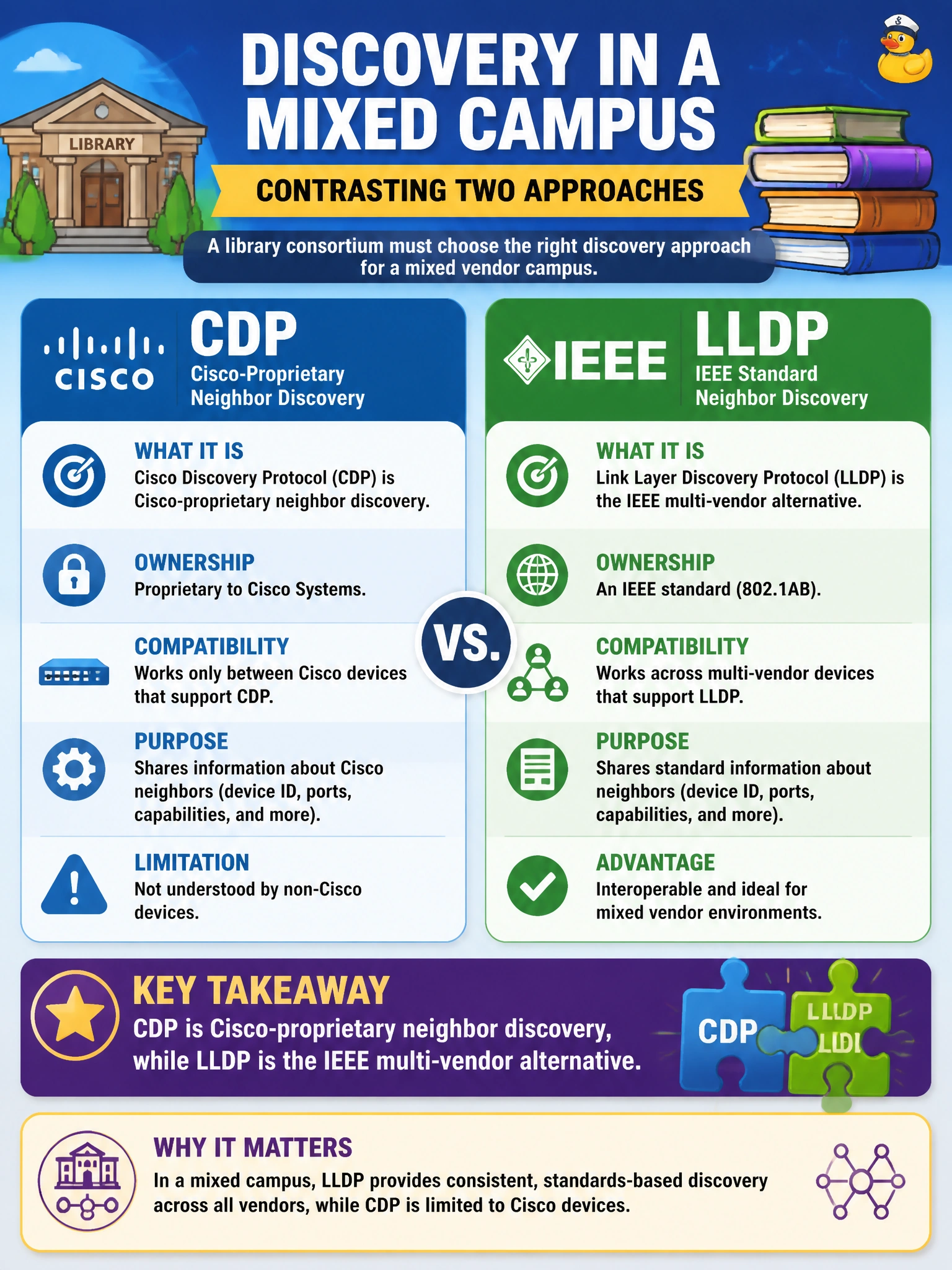
A library consortium documents a mixed campus and must contrast Cisco-proprietary discovery with standards-based discovery. Which comparison is accurate?
Select an answer to reveal the explanation.
Short Explanation
CDP is Cisco’s own name-tag protocol; LLDP is the industry badge that other vendors also wear. Same job—who’s on the other end of this cable—different club memberships.
Full Explanation
The accurate contrast for the library consortium’s mixed campus is simple and exam-critical: CDP is Cisco’s proprietary neighbor-discovery protocol, while LLDP is the IEEE 802.1AB multi-vendor alternative that performs a similar Layer 2 advertisement job. Both help operators learn who sits on the far end of a cable—device identity, local and remote interfaces, and related capabilities—but they differ in who implements them. CDP is ubiquitous on Cisco gear; LLDP is the interoperability choice when non-Cisco switches, phones, or cameras must participate.
Calling CDP and LLDP identical IEEE standards that differ only in CLI spelling is false: CDP is proprietary, LLDP is the IEEE standard. Claiming LLDP works only between routers and CDP only between wireless controllers invents device-class limits that do not define either protocol; both operate as Layer 2 discovery on Ethernet links among many device types. Saying CDP replaces Spanning Tree and LLDP replaces EtherChannel negotiation confuses discovery with loop prevention and link aggregation—those are separate control-plane functions.
Exam caveat: knowing which protocol is proprietary versus standards-based is frequently tested. Do not treat them as mutually exclusive campus-wide; many designs run both, and security policy may disable either on edge ports.
Operational check: document where CDP versus LLDP is required (Cisco-only uplinks versus multi-vendor access), verify neighbor tables for both as applicable, and ensure troubleshooting playbooks tell staff which show commands to use on each platform in the consortium.