
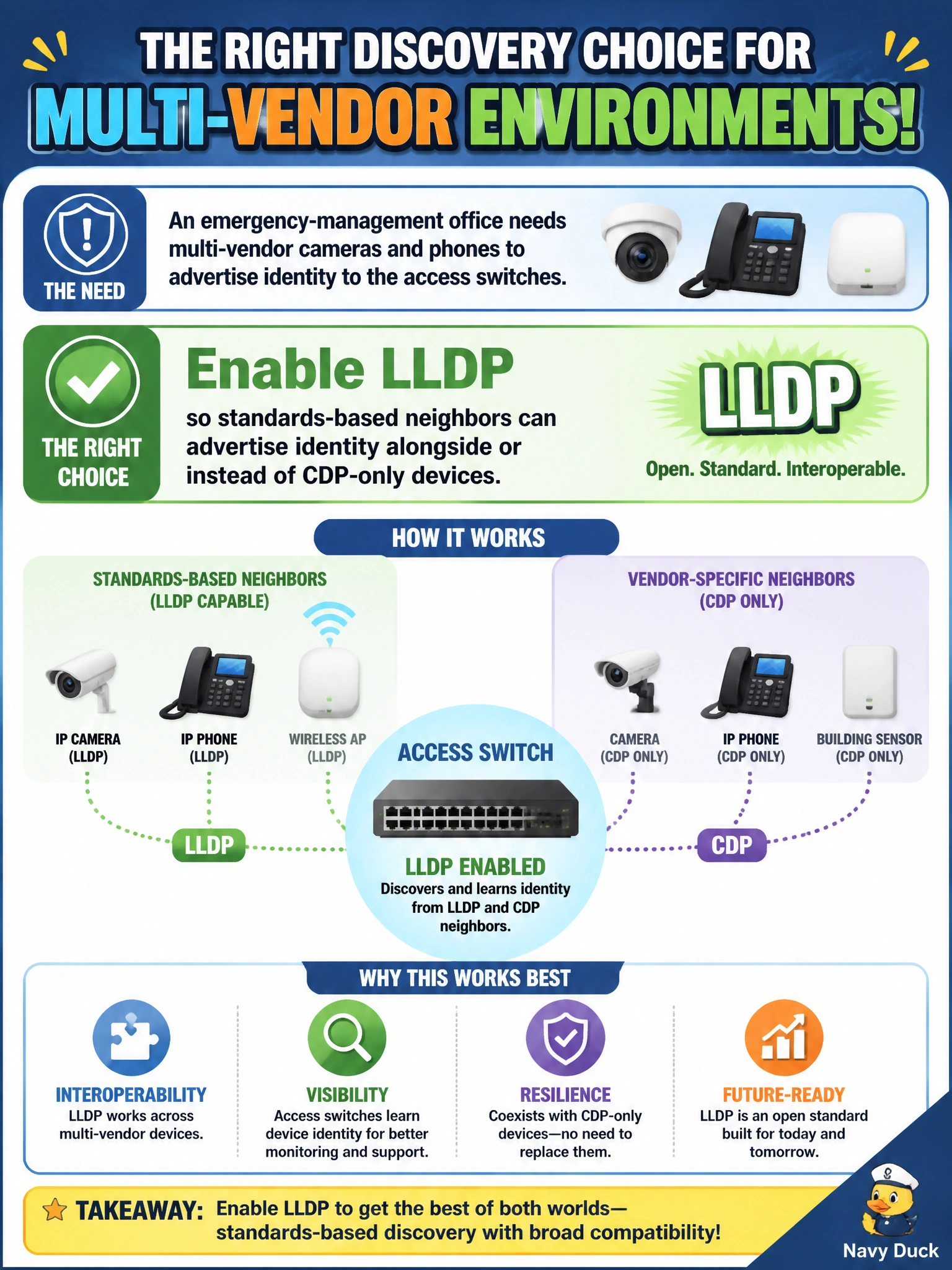
An emergency-management office needs multi-vendor cameras and phones to advertise identity to the access switches. Which discovery choice fits that mixed environment?
Select an answer to reveal the explanation.
Short Explanation
When the closet is a mix of brands, CDP is a Cisco-family reunion and LLDP is the open-house invite. Turn on LLDP so those cameras and phones can introduce themselves in a language everyone speaks.
Full Explanation
Emergency-management closets that mix vendor cameras and phones need a discovery protocol those endpoints can speak. LLDP (IEEE 802.1AB) is the standards-based Layer 2 discovery choice: multi-vendor devices advertise identity and capabilities to the access switch, with or without CDP still running for Cisco gear. Enabling LLDP gives the municipal access layer a consistent neighbor view across heterogeneous endpoints rather than depending on a Cisco-only handshake.
Using CDP exclusively fails because CDP is Cisco-proprietary and will not provide the same neighbor advertisement from many non-Cisco cameras and phones. Disabling all discovery and relying only on MAC OUI spreadsheets is slow, incomplete, and does not expose remote port or capability TLVs that operators use for documentation. HSRP on the access VLAN provides first-hop gateway redundancy; it does not register cameras as discovery neighbors or replace LLDP identity advertisement.
Exam caveat: LLDP and CDP can coexist. Choosing LLDP for multi-vendor environments does not require deleting CDP everywhere, and LLDP-MED extends useful endpoint information for phones without changing the core idea that LLDP is the open standard.
Operational check: enable LLDP globally and on relevant interfaces, verify neighbor entries for the mixed cameras and phones, retain CDP on Cisco uplinks if desired, and align discovery enablement with the security review so public or untrusted ports do not leak topology detail.