
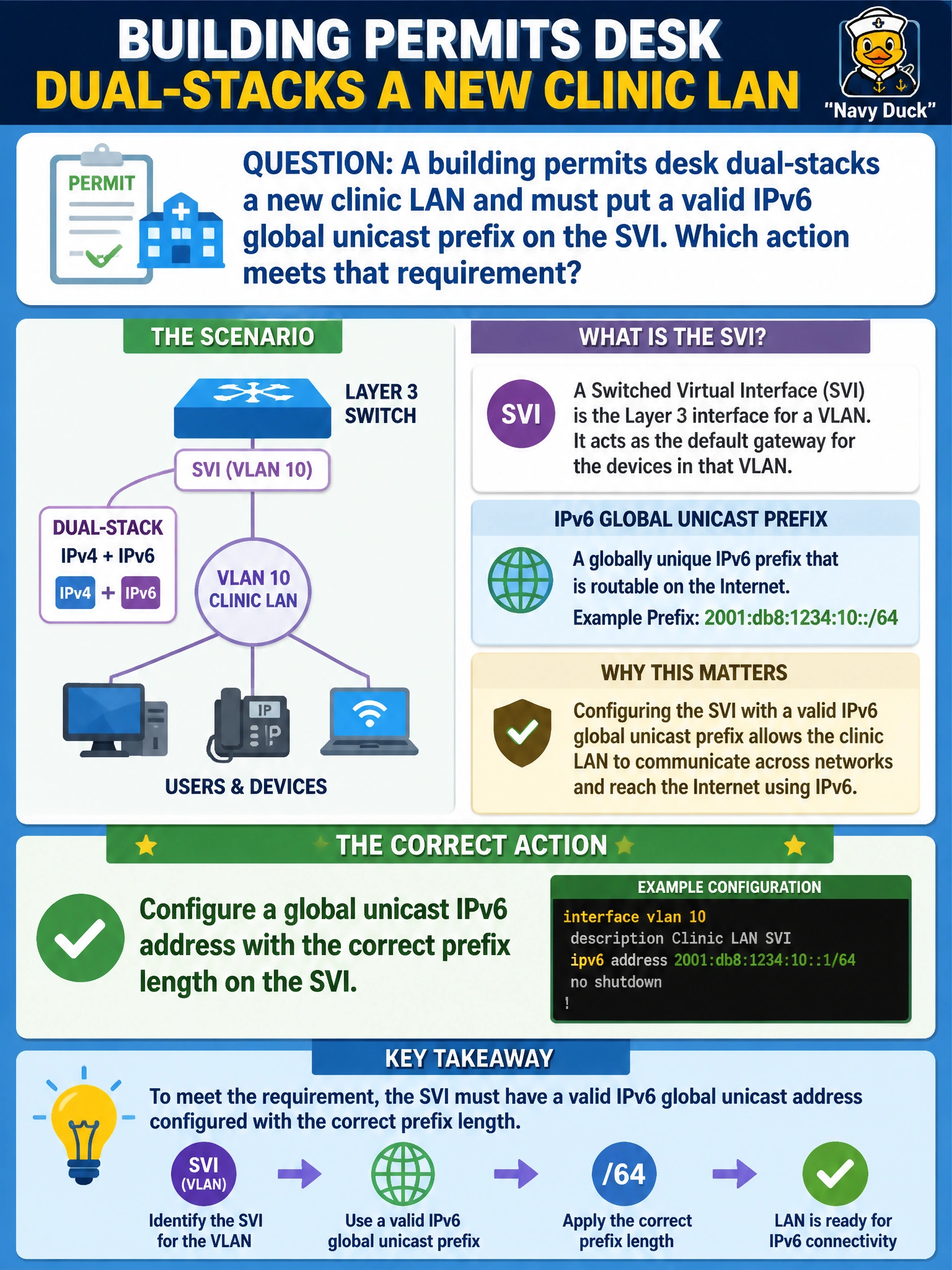
A building permits desk dual-stacks a new clinic LAN and must put a valid IPv6 global unicast prefix on the SVI. Which action meets that requirement?
Select an answer to reveal the explanation.
Short Explanation
For a dual-stack clinic LAN, you need a real IPv6 address and prefix on the SVI, not an IPv4 address relying on ARP or a multicast address used as unicast. Configure a global unicast address with the correct prefix length so hosts can use the SVI as their IPv6 gateway.
Full Explanation
A dual-stack clinic LAN needs both IPv4 and IPv6 Layer 3 identities on its SVI. To meet the IPv6 requirement, configure a global unicast IPv6 address with the correct prefix length—commonly /64 on an Ethernet LAN—so clinic hosts can use the SVI as their IPv6 default gateway and recognize the on-link prefix. Configuring only an IPv4 address and relying on ARP fails because ARP supports IPv4; IPv6 uses Neighbor Discovery, and IPv4 alone provides no IPv6 unicast service. Assigning an FF02:: multicast address as the SVI’s primary unicast address fails because multicast identifies a group, not a unicast identity for the SVI. Replacing the SVI with a loopback that uses only link-local addressing fails because it does not provide the clinic VLAN with a usable global on-link prefix for routed IPv6. Exam caveat: IPv6 interfaces have link-local addresses in fe80::/10, but a link-local address is not a global unicast prefix; configure the global address when the VLAN requires routed IPv6. Practical check: verify that the clinic SVI shows a global address with the planned prefix length, confirm hosts receive a matching prefix as designed, and ping the SVI and a remote IPv6 destination. The interface should show the global address, not merely a link-local address.