
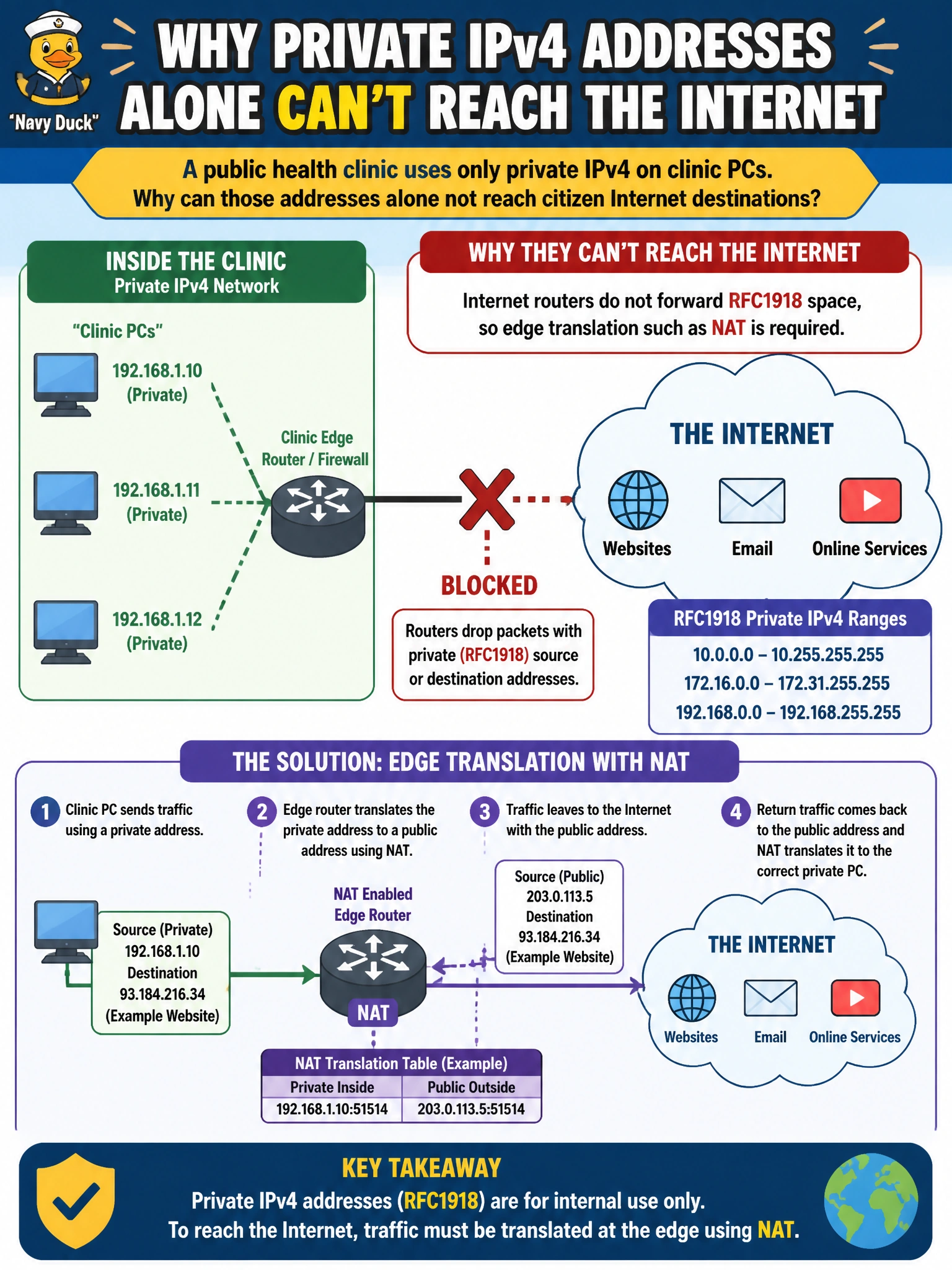
A public health clinic uses only private IPv4 on clinic PCs. Why can those addresses alone not reach citizen Internet destinations?
Select an answer to reveal the explanation.
Short Explanation
You can think of RFC1918 addresses as internal mail: public Internet routers do not forward them as globally routable traffic. Your clinic’s edge must translate them with NAT into a public address before packets can reach citizen Internet destinations.
Full Explanation
A public health clinic’s private RFC1918 addresses cannot reach citizen Internet destinations on their own because public Internet routers do not forward private address space as globally routable traffic. The clinic needs edge translation such as NAT, which gives outbound packets a public source address that can be routed across the Internet. The claim that private addresses automatically receive global routes from every ISP is incorrect: ISPs do not normally provide global forwarding for RFC1918 space. Disabling DNS does not make private addresses routable; DNS resolves names to addresses but cannot change how Internet routers forward packets. Translating private IPv4 addresses into public MAC addresses also confuses networking layers: MAC addresses identify devices on a local link, while Internet reachability depends on IP addressing and routing, with NAT at the edge providing the needed public IP identity. Exam caveat: when a question says a network uses only private IPv4 addresses, look for NAT or another form of edge translation—not a DNS change or MAC-address conversion. Practical check: capture outbound Internet traffic from a private clinic PC and confirm that the clinic edge translates its source address to a public address; also verify that the NAT rule and public interface’s default route are working.