
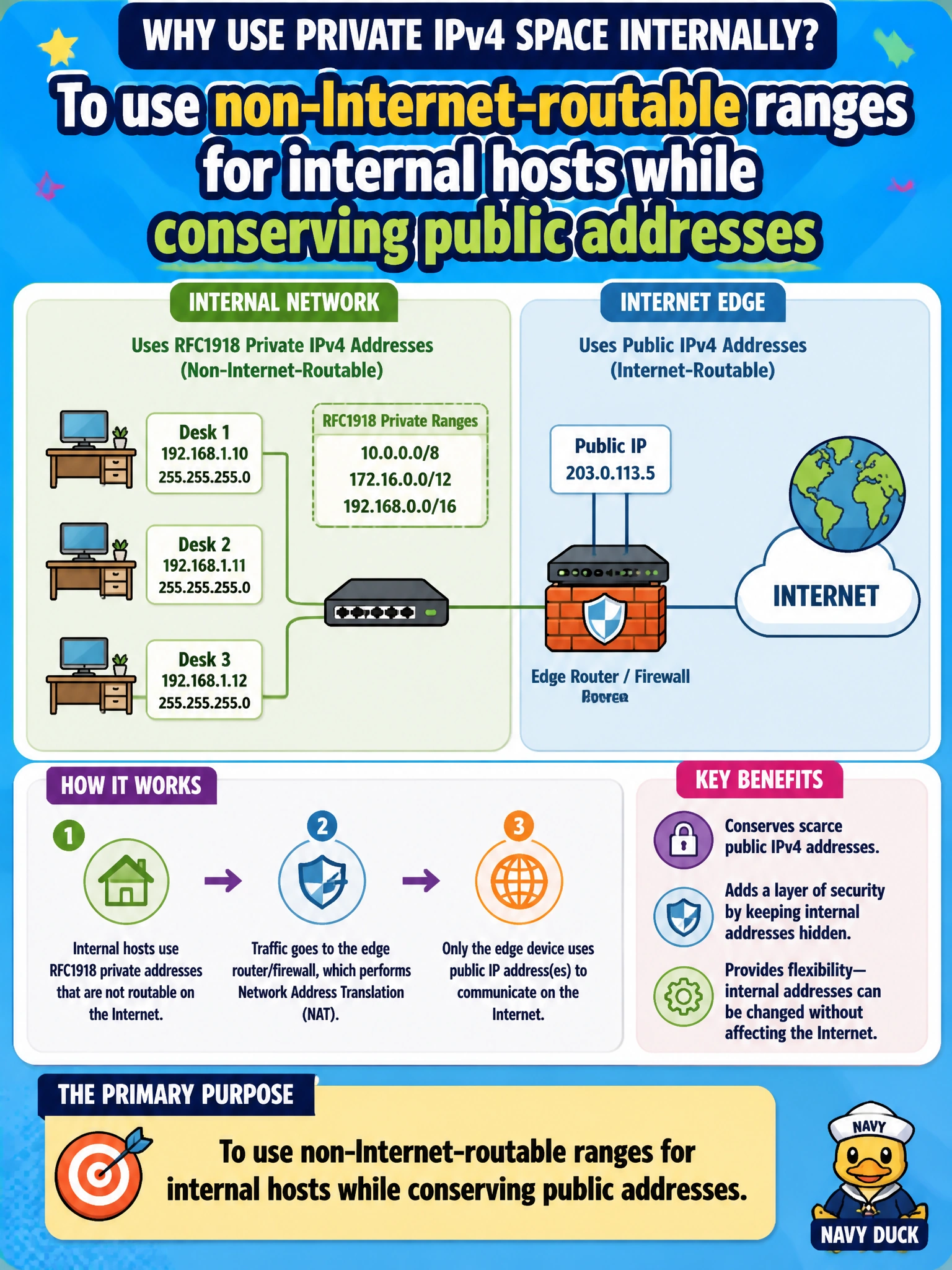
A city clerk assigns RFC1918 addresses to internal desks and keeps public IPs only on the Internet edge. What is the primary purpose of using private IPv4 space internally?
Select an answer to reveal the explanation.
Short Explanation
Private ranges are the city’s internal phone extensions — great inside the building, not dialable from the public Internet. You save scarce public numbers for the edge and keep desks on RFC1918.
Full Explanation
A city clerk assigns RFC1918 addresses to internal desks and keeps public IPs only on the Internet edge. The primary purpose of private IPv4 space (10/8, 172.16/12, 192.168/16) is to number internal hosts with addresses that are not globally routable on the public Internet, thereby conserving scarce public IPv4 addresses for edge services, NAT pools, and published systems. Desks, printers, and most campus servers can live entirely inside RFC1918 while a small set of public addresses fronts the WAN.
Guaranteeing every desk a globally unique Internet-routable address is the opposite of the private-addressing goal and would exhaust public space. Replacing Ethernet with a non-IP municipal protocol is unrelated to RFC1918. Forcing all internal traffic onto IPv6 link-local only is neither required nor a purpose of IPv4 private ranges; link-local IPv6 does not replace RFC1918 planning for IPv4 campuses.
Exam caveat: private addresses still need routing inside the enterprise and typically NAT/PAT (or proxy) at the edge for Internet access. “Private” means not Internet-forwardable by default, not “no routing anywhere.”
Operational check for city hall: confirm internal VLANs use RFC1918, edge interfaces or NAT pools use public space, and Internet traceroute from a desk shows translation at the edge. Attempting to advertise RFC1918 to an ISP should be filtered; verify ACLs/prefix-lists prevent accidental leakage of private space outbound.