
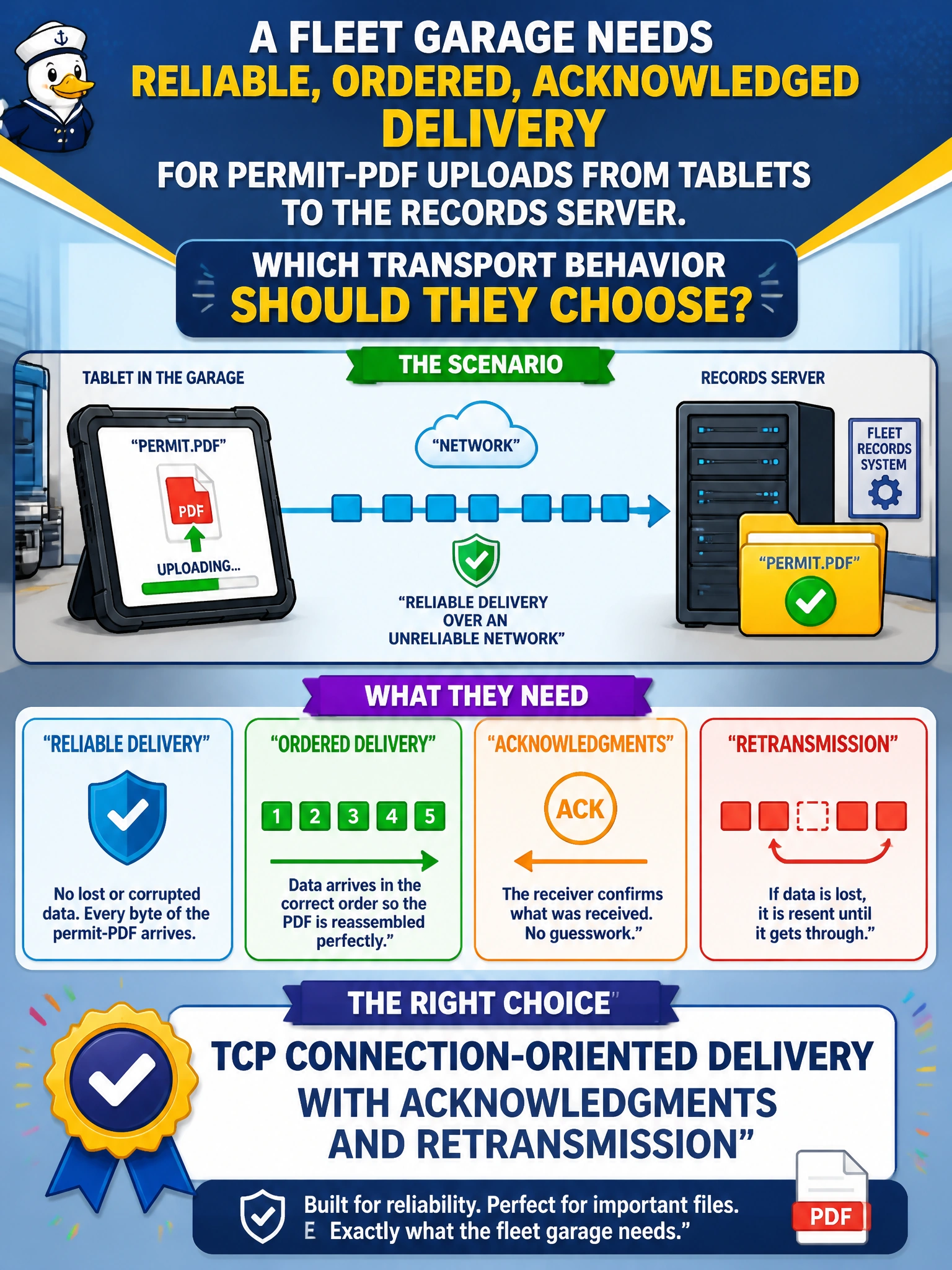
A fleet garage needs reliable, ordered, acknowledged delivery for permit-PDF uploads from tablets to the records server. Which transport behavior should they choose?
Select an answer to reveal the explanation.
Short Explanation
Permit PDFs are like certified mail—you want a signature that it arrived in order. TCP does handshakes, ACKs, and retransmits. UDP just tosses the package and hopes.
Full Explanation
Permit-PDF uploads from fleet-garage tablets to a records server need reliable, ordered, acknowledged delivery with retransmission of lost data. TCP provides connection-oriented transport: handshake, sequencing, acknowledgments, and retransmission—so the PDF bytes arrive complete and in order. That transport behavior matches the operational requirement for file uploads where correctness matters more than shaving handshake overhead.
UDP fire-and-forget with no retransmission of lost segments fails because lost datagrams are not recovered by UDP itself; PDF corruption or truncation would be left to the application. Raw Ethernet broadcasts with no transport-layer reliability fail by concept—they are not an end-to-end reliable file transport across routed municipal networks. ICMP echo only, which cannot carry application file payloads, fails because ping is reachability diagnostics, not a file-transfer transport.
Exam caveat: Reliable file transfer → TCP. Real-time loss-tolerant media often → UDP. Do not pick ICMP or raw broadcasts as substitutes for transport reliability.
Operational check: Ensure the upload application uses TCP (HTTPS, SFTP, etc.), verify tablets can complete the three-way handshake to the records server, and confirm failed transfers retry rather than silently dropping bytes. Packet captures showing missing ACKs/retransmits under loss illustrate why TCP was required for permit PDFs.