
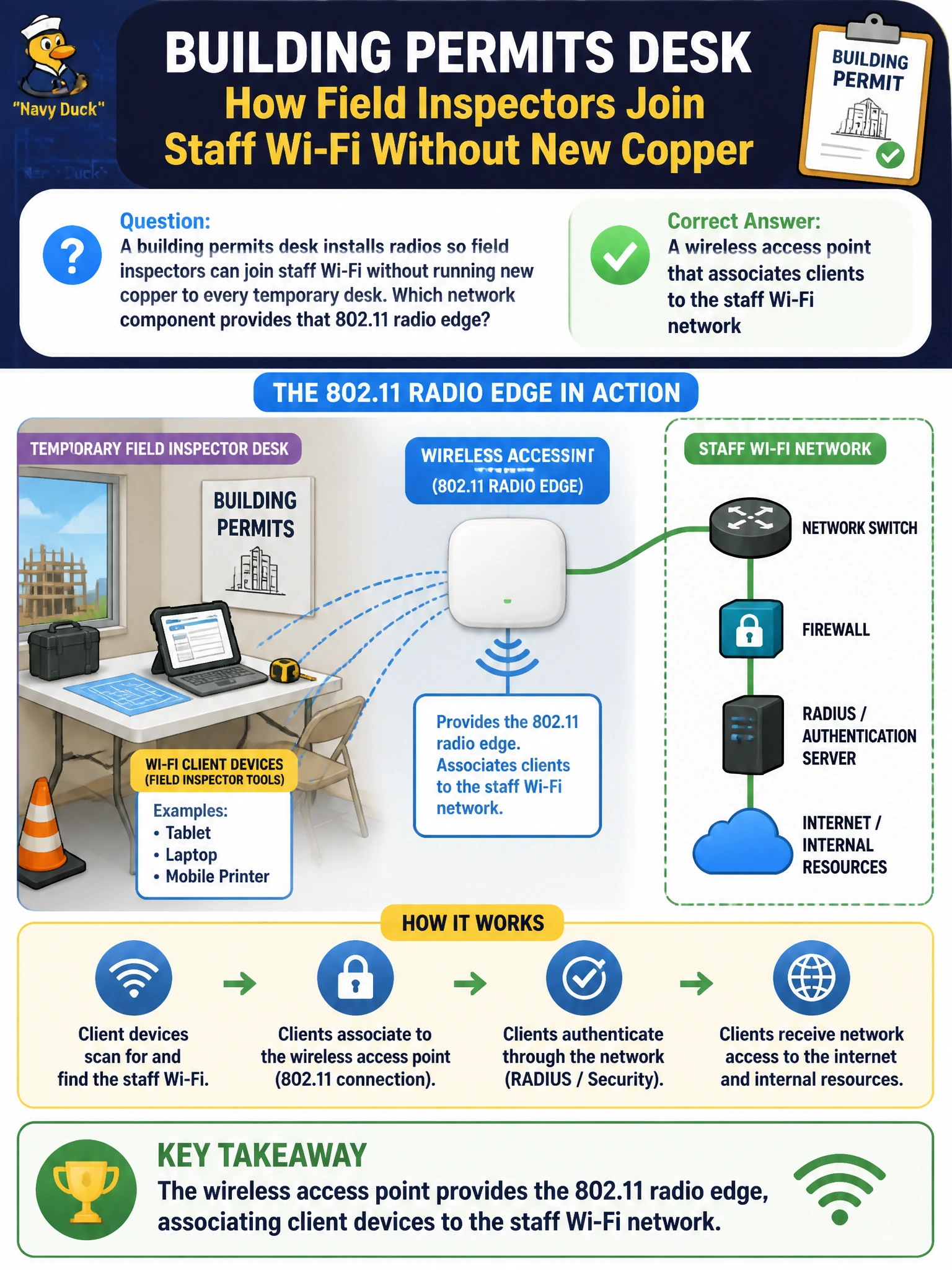
A building permits desk installs radios so field inspectors can join staff Wi-Fi without running new copper to every temporary desk. Which network component provides that 802.11 radio edge?
Select an answer to reveal the explanation.
Short Explanation
You need a Wi-Fi on-ramp at the temporary desks, and the wireless access point provides it by associating inspectors’ devices with staff Wi-Fi. A router forwards packets between IP subnets, an SFP carries optical traffic between closets, and RADIUS stores passwords; none provides the 802.11 radio edge.
Full Explanation
Field inspectors at a building permits desk need 802.11 radio attachment so they can join staff Wi-Fi without new copper at every temporary desk. The wireless access point provides that radio edge: it associates client devices and bridges or tunnels their traffic into the wired campus, serving as the Wi-Fi on-ramp for the desk area. That is the right role when the requirement is specifically radio connectivity rather than routing, optical transport, or identity storage. A Layer 3 core router that only forwards packets between IP subnets does not create an 802.11 radio or let inspectors associate; routing cannot replace the wireless access point. A fiber SFP transceiver carries optical traffic between network closets, so it is a media module for fiber links, not a client-facing radio. A RADIUS server that only stores user passwords and has no radio function supports identity services, but it cannot radiate Wi-Fi or associate 802.11 clients. Exam caveat: distinguish the wireless edge from Layer 3 forwarding, fiber transport, and authentication; a complete network may use all these functions, but the requested radio edge is the access point. Practical check: confirm the access point is powered, advertises the staff SSID, and allows inspector devices to associate and receive connectivity. Healthy routing, fiber, or RADIUS alone does not provide radio coverage at temporary desks.