
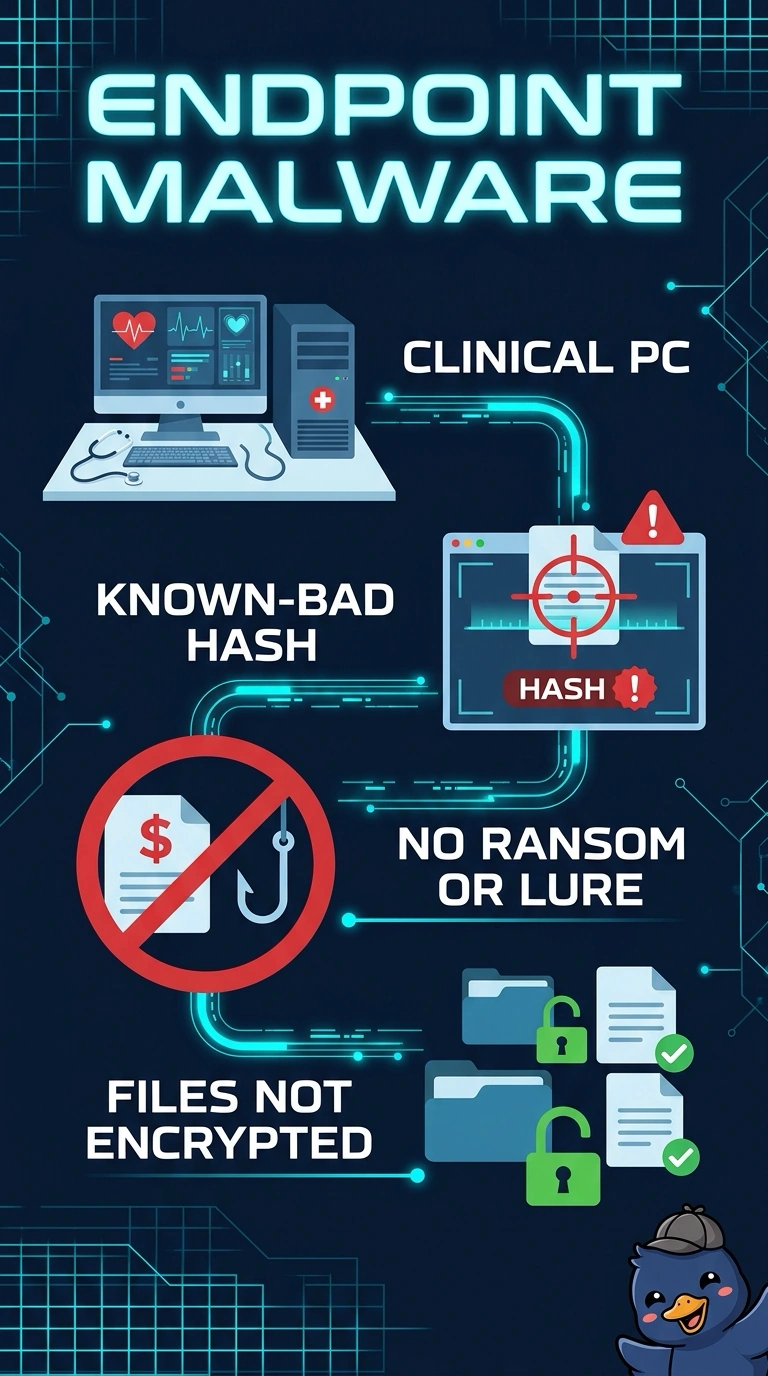
At a hospital, an unwanted program with a known-bad hash is resident on a clinical PC, has not encrypted any files, and is not a document lure. Which attack category fits that program?
Select an answer to reveal the explanation.
Short Explanation
You’ve got a known-bad program resident on the clinical PC, so this is endpoint malware. Social engineering leaves no unwanted program on the PC, a distributed denial-of-service attack floods the network from many outside hosts, and a VLAN misconfiguration puts the PC on the wrong segment—none matches what you found.
Full Explanation
Endpoint malware is unwanted code resident on a host. A known-bad hash identifies the program on the clinical PC; no files were encrypted, and the case is not a document lure. That makes malware resident on the clinical endpoint the fitting category. Social engineering aimed at staff, with no unwanted program left on the PC, requires a person manipulating someone, whereas a program is already resident here. A distributed denial of service flooding the clinical network from many outside hosts is a volume attack against availability, not a program on one clinical PC. A VLAN misconfiguration that places the PC on the wrong hospital network segment is a placement error; it does not account for a known-bad program resident on the endpoint. The hash match supports classifying that program as malware without waiting for encryption or a document lure. Exam caveat: malware is the broad category; a ransom outcome would require encrypted files or a payment demand, and neither is present in this case. Practical check: find the file whose hash matches the known-bad value and record its path on the clinical PC before removing it.