
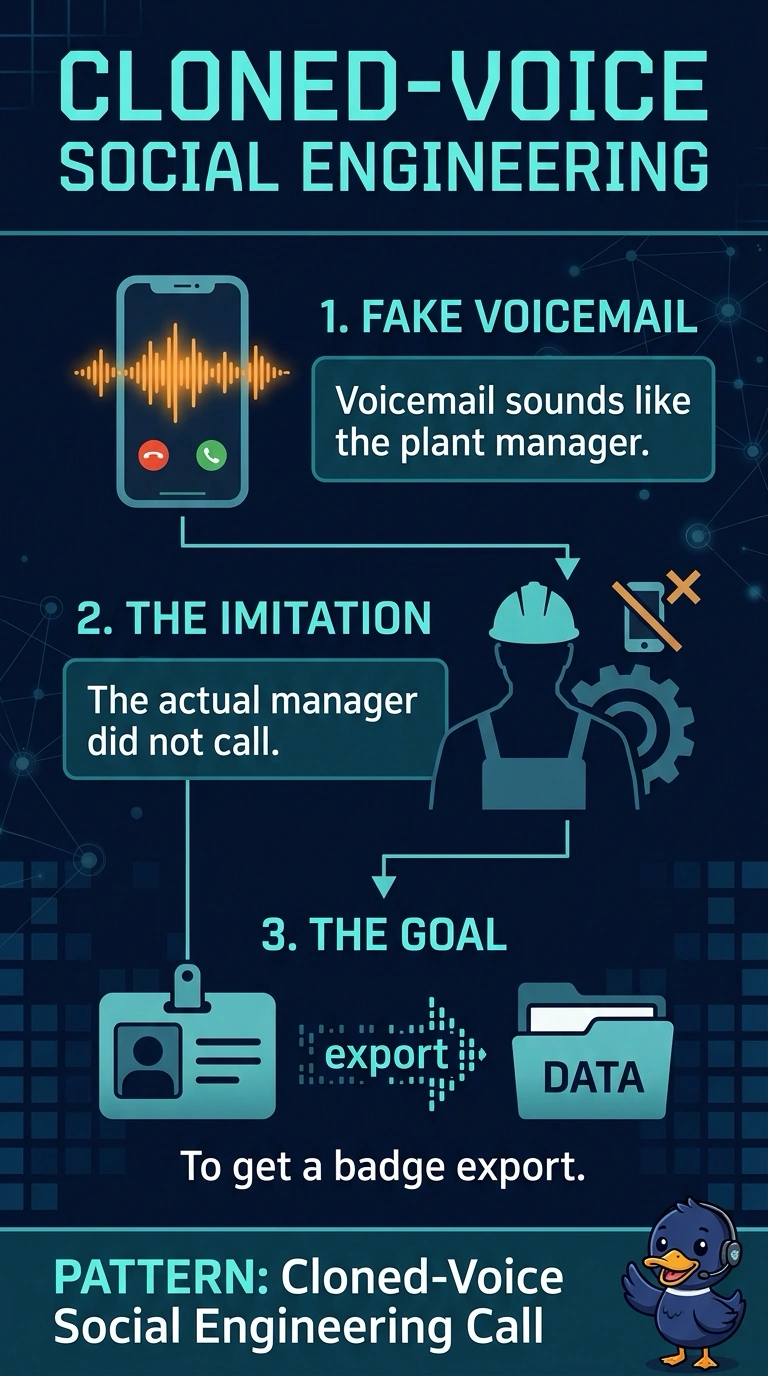
At a manufacturer, a voicemail sounds like the plant manager and asks maintenance to email a badge export, but the manager is in a meeting and did not call. What pattern is this?
Select an answer to reveal the explanation.
Short Explanation
A familiar voice on the phone can be a recording in a costume. You have a cloned-voice pretext asking for a badge export the real manager did not request. The trap is calling it a network attack or a database injection when nobody touched a packet or a query.
Full Explanation
The voicemail imitates the plant manager and asks maintenance to send a badge export, while the manager is in a meeting and did not place the call. That is social engineering by voice. A voice can be cloned or closely imitated, and the pattern is the pretext, not a flaw in a protocol. The pattern is "A cloned-voice social-engineering call imitating the plant manager to get a badge export". "An ARP attack that rewrites the plant switch table so later frames follow a false path" would change MAC-to-IP mappings on the local network, and this incident is a spoken request with no frame rewrite described. "A SQL injection against the badge database that extracts the export without any phone call" would place database syntax in an application input, and the request arrived as voicemail rather than as a query. "A failed overnight backup of the badge store that left maintenance without a current file" is an operations failure, not an impersonation asking someone to email the data out. Exam caveat: a convincing voice is not proof of identity, including when the voice may have been synthesized, so the check is whether the real person made the request. Operational check: reach the plant manager on a known number while they are still in the meeting, and do not email the badge export based on the voicemail.