
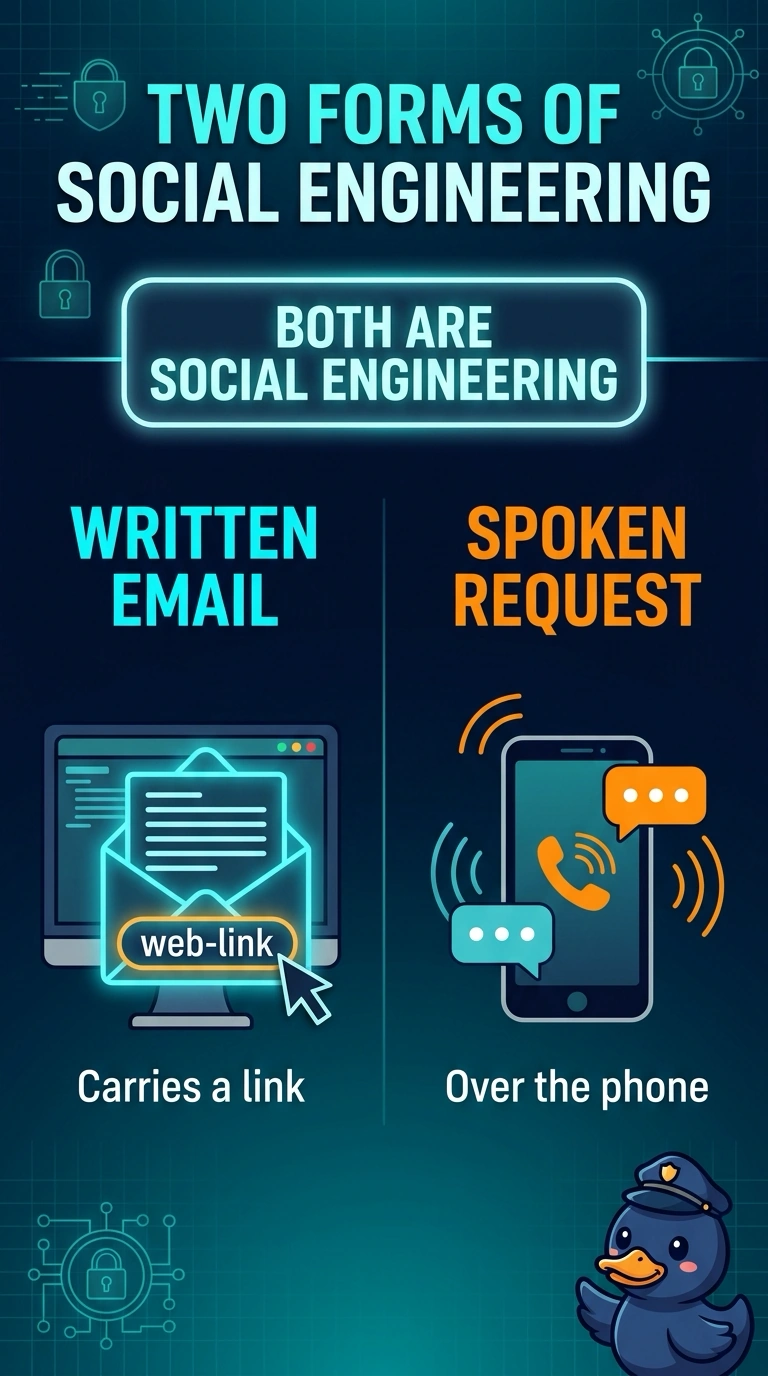
At a hotel, one guest emails the manager a link, and a different guest makes the same request by phone. What do those two contacts have in common?
Select an answer to reveal the explanation.
Short Explanation
Two costumes, one con: a note under the door and a voice in the hallway. You are looking at social engineering in writing and again by phone. The trap is calling both contacts a web injection, ransomware, or a NAT failure.
Full Explanation
Social engineering is persuasion aimed at a person. One guest sends the manager an email that carries a link, and another guest makes the same request by phone, so the shared pattern is a human pretext on two channels, one written and one spoken. The link is not described as injected script, and the phone call cannot be a browser injection. What they share is "Both are social engineering, one a written email that carries a link and one a spoken phone request". "Both are cross-site scripting, one inside the mail client and one inside the phone app" would require script executed in a victim's web session, and a spoken request has no such execution. "Both are ransomware, one delivered by a link and one delivered by a spoken payment demand" would require malware encrypting files or a ransom for keys, and the scenario is only a repeated request. "Both are NAT problems, one on the guest wireless path and one on the hotel phone path" would be address translation hiding or breaking flows, and nothing here describes a translation failure. Exam caveat: the channel can be email or voice and the class is still social engineering when the target is a person's trust. Operational check: warn the manager, preserve both the email and a note of the call, and verify any request through a hotel contact that neither guest supplied.