
At a university, students say they can spot fake mail by grammar, but a lure arrives with perfect grammar and a real course name and asks for a course password. What is the better check?
Select an answer to reveal the explanation.
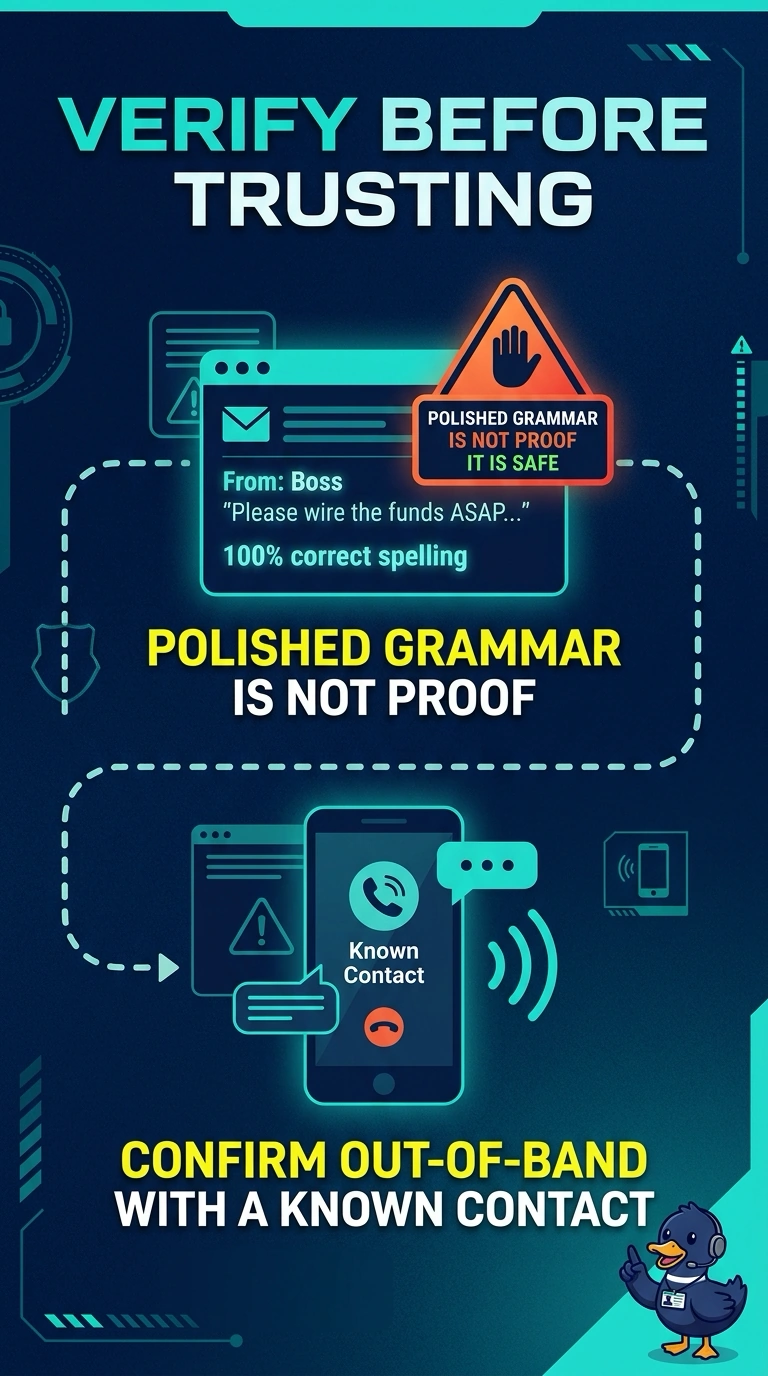
Short Explanation
A neatly typed note can still be from the wrong person. You confirm the password request with a known contact on a channel outside the email. The trap is trusting perfect grammar, a real course name, or a clean filter score.
Full Explanation
Social engineering is a person, or a tool writing for a person, persuading someone to give up a secret. Perfect grammar and a real course name show that the lure was prepared with good source material, and they do not show that the named sender wrote it. Generative tools make clean prose common, so the better check is a contact the message cannot rewrite. The better check is "Confirm the request out of band with a known contact, and do not treat polished grammar as proof it is safe". "Treat perfect grammar plus a real course name as proof the message is safe to trust and open" is the students' rule, and it fails as soon as the lure is well written and well researched. "Treat a spam score of zero as proof the message is safe for students to open and follow" confuses a filter's opinion of bulk-mail traits with proof of who sent the message. "Delete the course syllabus so that course name can no longer appear inside a lure message" removes a public fact the attacker can learn elsewhere, and it does not stop a password request. Exam caveat: grammar, spelling, and a familiar name are weak tells once messages can be polished, and the exam control is out-of-band verification. Operational check: have the student call or message the instructor on a number or account already on the syllabus, and do not send the password until that person confirms the request.