
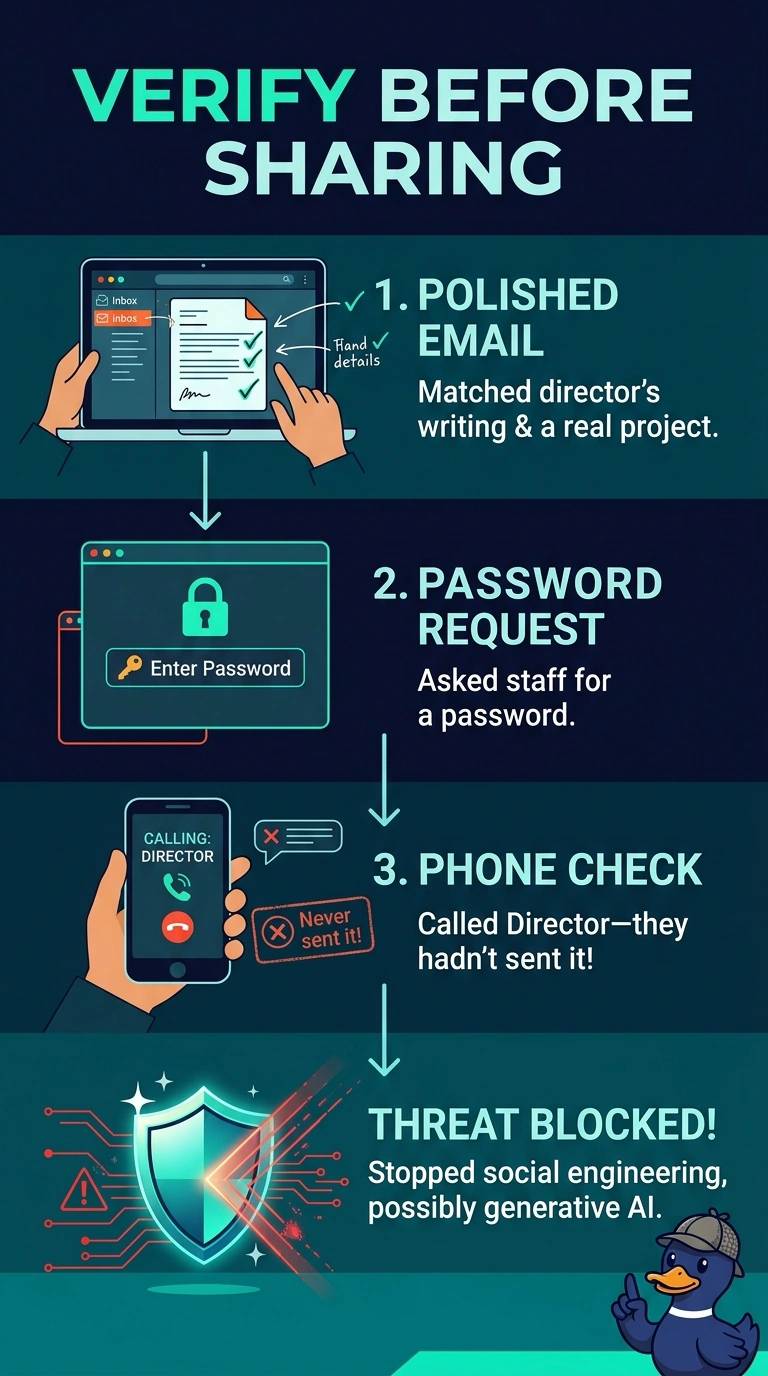
At an agency, an email matches the director's writing, cites a real project, and asks for a password. A phone call to the director shows the director did not send the email. What did that second channel stop?
Select an answer to reveal the explanation.
Short Explanation
A perfect costume can still be a stranger at the door. You stopped a polished request for a password by calling the real director on a known line. The trap is hunting for a virus or an outage when the mail never needed malware.
Full Explanation
The phone call is an out-of-band check, and it showed the director did not send the message. The email copies a real writing style, names a real project, and still asks for a password, which is a social-engineering lure. Polished wording can come from a person or from generative AI, and neither one is proved or disproved by grammar. The second channel stopped "A polished social-engineering lure, possibly generative AI, that asked staff for a password". "A signature antivirus detection on the workstation that opened the message and executed code" would require a known-bad file or a running payload, and this case is a request for a password with no code described. "A distributed denial-of-service flood aimed at the agency mail gateway during that same hour" is a volume attack on availability, not a targeted request that a phone call to one person can refute. "A certificate name mismatch on the agency mail server that rejected the director message" is a name on a certificate failing to match a host, and the director's denial is about authorship, not about a certificate. Exam caveat: bad grammar is not a reliable tell once generative tools can write clean mail, so the control is a check on a channel the sender does not control. Operational check: call the director on a number from the agency directory, not a number in the email, and record that the password was not disclosed.