
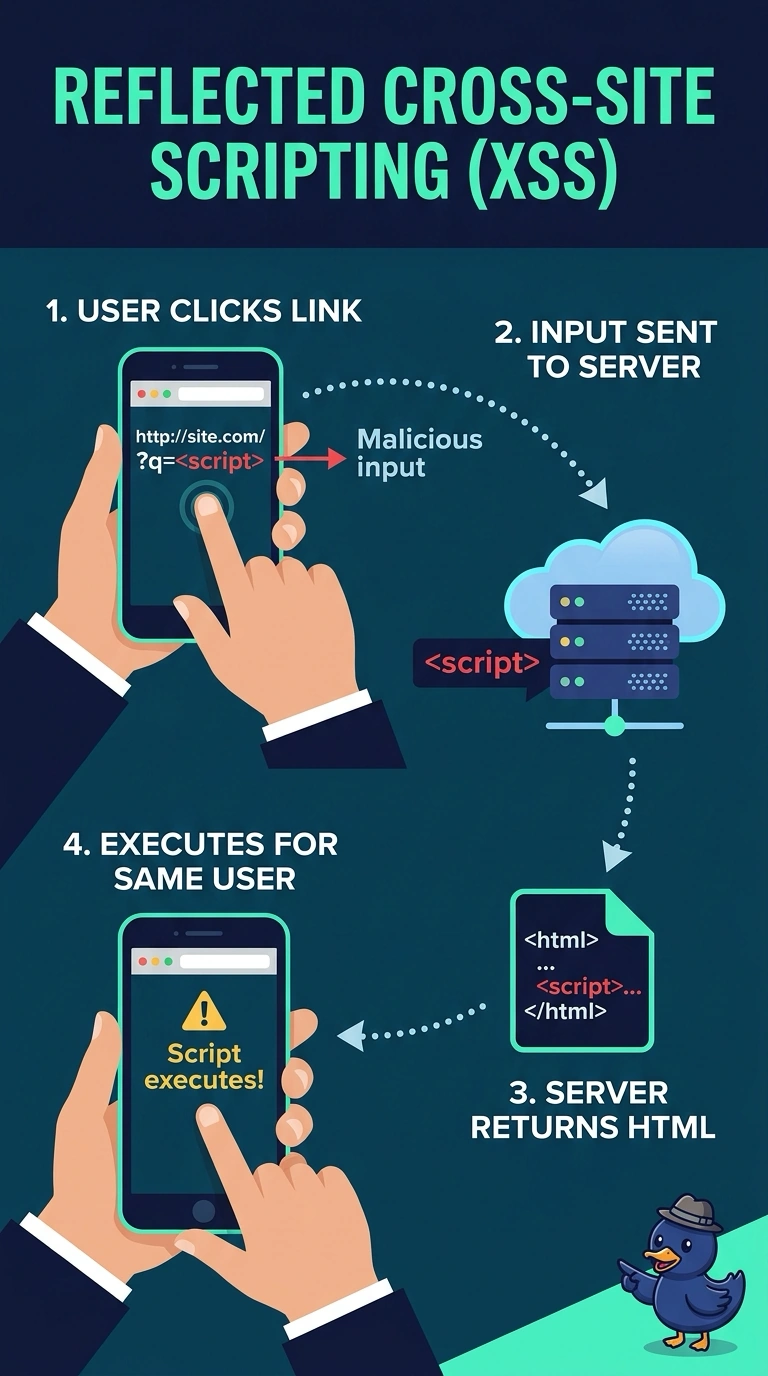
At a hospital, a patient-portal page places input from a clicked link into the HTML returned to that same person, and the response shows no database error. Which attack fits?
Select an answer to reveal the explanation.
Short Explanation
A message bounced straight back onto the reader's own page is a browser problem, not a locked file cabinet. You see the link input reflected into HTML for the person who clicked, with no database error. The trap is calling that a query attack, a flood, or ransomware.
Full Explanation
Reflected cross-site scripting takes input from the request and places it into the HTML of the response for the person who sent or clicked it, so that browser can execute it. The portal returns the link input in the HTML of the same person and shows no database error, which fits reflection into the browser rather than a database failure. Reflected cross-site scripting that returns the link input in HTML to the person who clicked the link is the attack that fits. SQL injection that rewrites the portal query and can surface a database error or extra rows for staff would target the query, and this page shows HTML reflection without a database error. A distributed denial of service that overwhelms the patient portal with volume from many sources is a capacity attack, and one reflected response is not a flood. Ransomware that encrypts patient-portal files on the hospital server and then demands a payment encrypts files for payment, and the evidence is reflected HTML, not encrypted files. On the exam, the absence of a database error is not the whole proof; the reflected input in the HTML is what makes this cross-site scripting. In operations, capture the response and confirm the supplied input appears in the HTML returned to that client.