
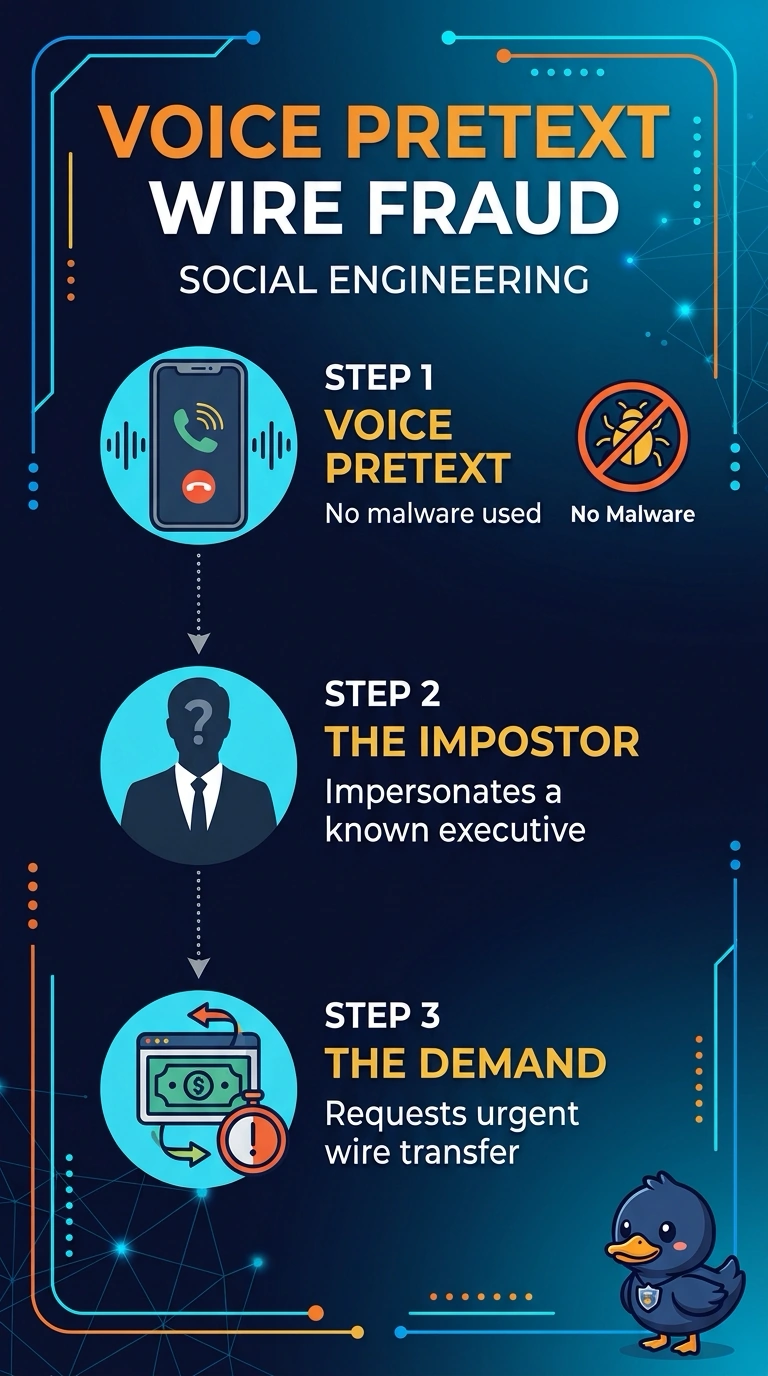
At a bank, a person calls the wire desk, pretends to be a known executive, and demands an urgent transfer, and there is no malware on the call. Which attack is this?
Select an answer to reveal the explanation.
Short Explanation
A familiar voice on the phone, asking the vault clerk to move money, is a person at work, not a broken program. You have a caller pretending to be an executive and pushing an urgent transfer, with no malware on the line. The trap is reaching for SQL injection, a buffer overflow, or a NetFlow spike.
Full Explanation
Social engineering by voice pretext uses a person on the phone, a claimed identity, and urgency to persuade staff to take an action. The caller pretends to be a known executive and demands an urgent transfer, and there is no malware on the call, so the attack is the pretext itself. The attack that matches the call is this: Social engineering by voice pretext, with the caller impersonating a known executive to demand an urgent wire transfer. SQL injection against the wire-desk application, built from a quote typed into a transfer field, requires hostile input in a database query, and this incident is a phone call with no such input described. A buffer overflow in the desk-phone software that runs caller-supplied code on the wire-desk computer requires a memory flaw and code execution, and no malware or software exploit is on the line. A NetFlow anomaly on the voice path, scored from unusual call volume without any spoken pretext, is a traffic statistic and ignores the human request that is the actual attack. On the exam, a familiar voice or a polished delivery is not proof the caller is the executive, and out-of-band verification on a number the bank already holds is the control. In operations, pause the wire and reach the executive through the official directory before the transfer is released.