
At a logistics hub, a GRE-style wrapper carries an inner conversation whose addresses are not the addresses on the outer header a sensor indexed. What is the monitoring impact?
Select an answer to reveal the explanation.
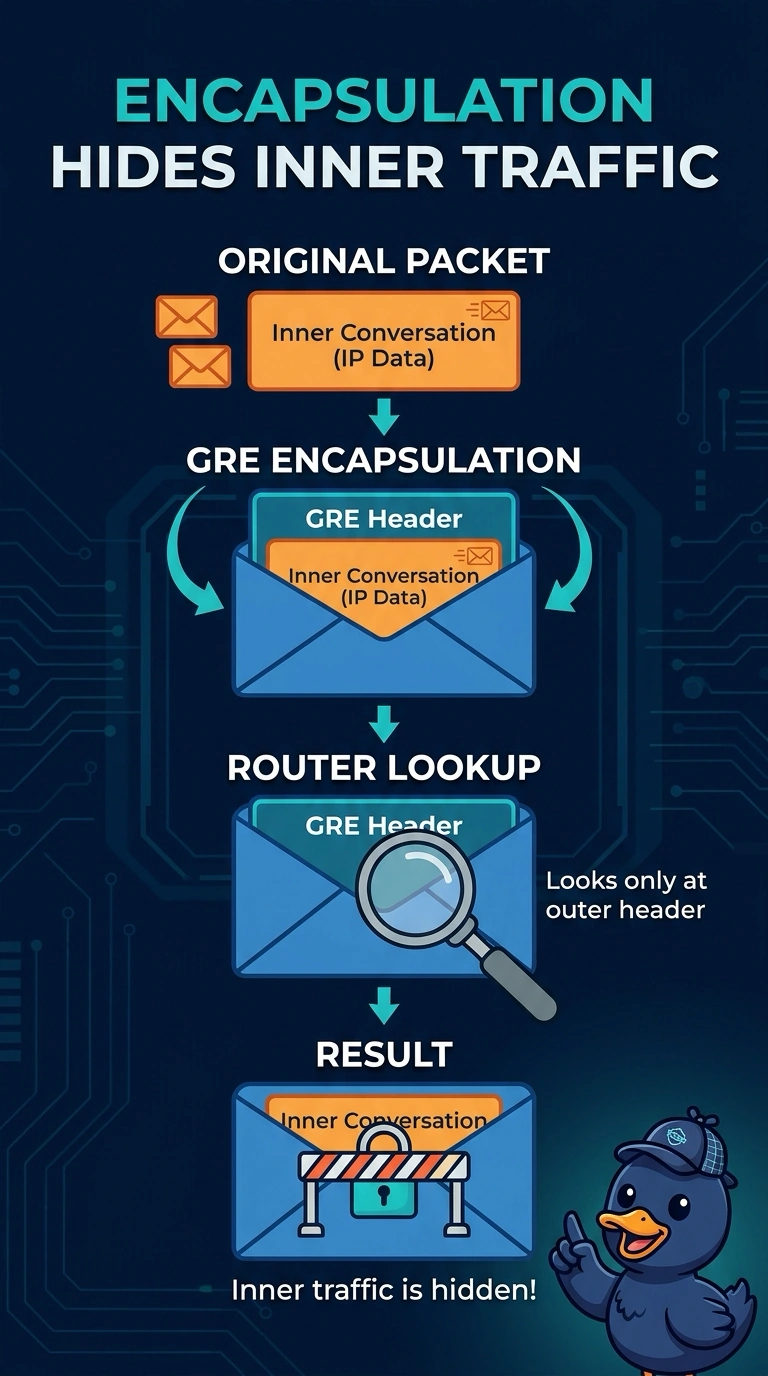
Short Explanation
The label on the outer carton is not the letter packed inside, and a clerk who files only the label misses the letter. You indexed the outer header, so the inner addresses never entered that lookup. The trap is assuming the sensor dropped the packet, that translation wrote the inner address, or that a file hash changed.
Full Explanation
Encapsulation hides the inner conversation from a lookup built only on the outer header is the impact. A GRE-style wrapper puts the original conversation inside an outer packet, and the sensor's index used the outer header. A lookup on those outer addresses returns the tunnel endpoints, not the inner pair, so the real conversation is hidden from that lookup. The sensor dropped the packet instead of indexing the wrapped conversation for review says the sensor discarded the packet. The stem says the sensor indexed the outer header, which means the packet was recorded at that layer rather than dropped. Address translation selected the inner address now written on the header that was indexed describes translation rewriting an address onto the header that was indexed. Encapsulation leaves the inner addresses inside the wrapper; it does not write them onto the outer header the sensor stored. The hash of a transferred file changed while the file moved between the two inner hosts is a file-integrity claim. A changed hash says nothing about why an outer-header lookup misses the inner addresses. Exam caveat: if the wrapper is removed, the inner headers can be read. The blind spot is a lookup that uses only the outer header the sensor indexed. Operational check: compare the indexed outer source and destination with the inner pair after decapsulation before you name the two hosts that actually exchanged the files.