
The same bank transfer appears as four summary lines in one monitoring note. Which line describes the impact of NAT rather than the impact of encryption?
Select an answer to reveal the explanation.
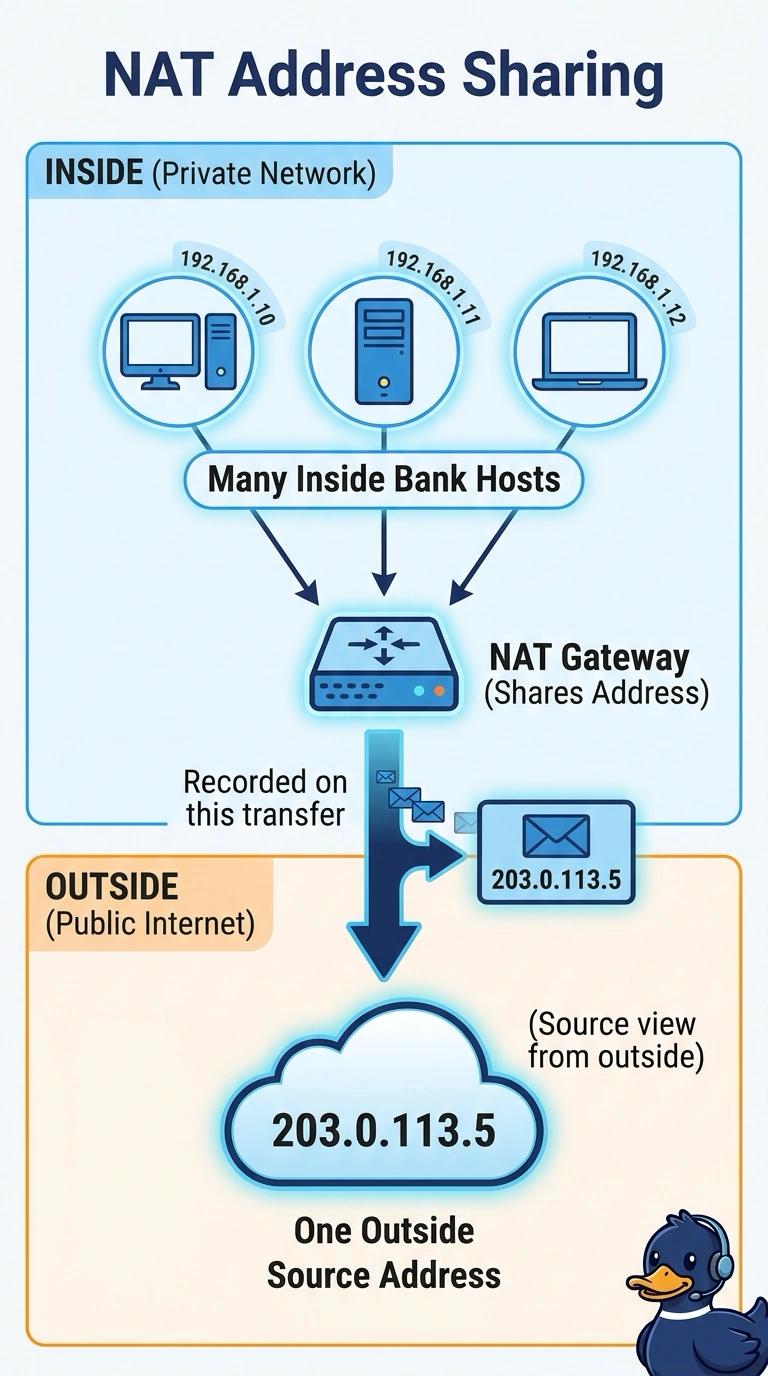
Short Explanation
Lots of households writing one shared return address is an addressing trick, not a sealed letter. You want the line where many inside hosts share one outside source address. The trap is an unreadable payload, a social-media category, or a stripped mail attachment.
Full Explanation
Many inside bank hosts share one outside source address on this recorded transfer is the NAT line. Many inside hosts using one outside source address is what many-to-one address translation does to the recorded transfer: the outside view no longer shows a unique inside source. That is an addressing effect, not a statement about whether the payload can be read. The transfer payload is unreadable in the packet capture stored for that same session is the encryption impact. An unreadable payload means the content is hidden, and it says nothing about inside hosts sharing an outside address. The web filter assigns the related browsing session to a social-media URL category label is a web-filter classification. Putting browsing in a social-media category describes content policy, not address translation and not encryption. The mail gateway stripped the attachment before the message was delivered to the inbox is an email-filter action. Removing an attachment before delivery changes the message the inbox receives, and it is neither NAT nor the unreadability of a packet capture. Exam caveat: one-to-one translation would not place many inside hosts on a single outside source address. The line in the note is the shared-address case, and the outside address alone does not identify which inside host it was. Operational check: match the outside source address and the time of the transfer to the firewall translation log to recover the inside host before you name who sent it.