
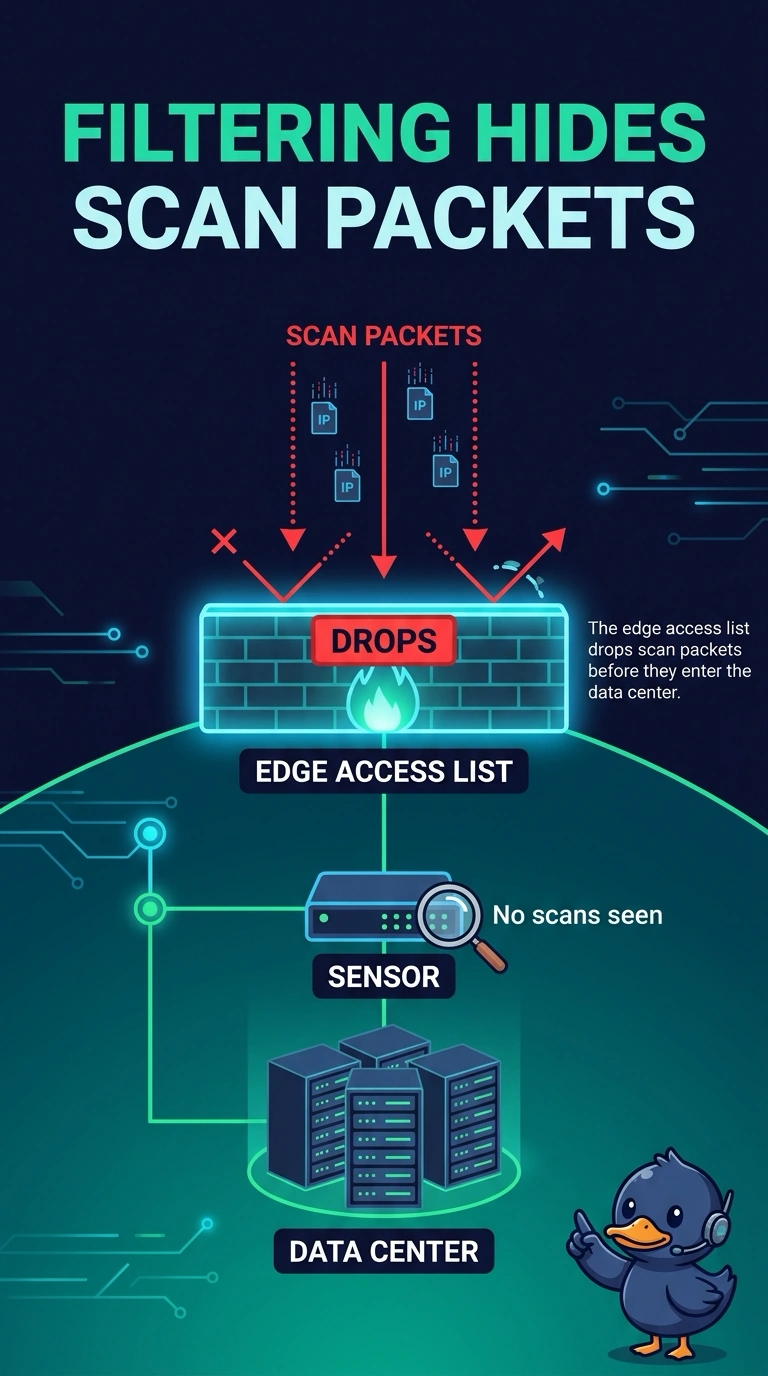
At a bank, a sensor inside the data center never sees scan packets that the edge access list drops before they enter the data center. What visibility impact does that filtering have?
Select an answer to reveal the explanation.
Short Explanation
A bouncer who turns people away on the sidewalk keeps them off your lobby camera. The edge access list drops the scans before they reach the data-center sensor, so those packets never enter the picture. Translation, encryption, and load balancing do not delete traffic the list already stopped.
Full Explanation
A sensor can record only packets that reach it. An access list in front of the sensor that drops the scans before those packets can be seen removes the scans from the data-center view, which is why the inside sensor stays quiet. Network address translation, still able to show a translated session when the scans are allowed through, would leave a translated session to observe if the edge had permitted the scans. Encryption on an allowed flow, hiding payload bytes while the conversation itself stays visible, would conceal contents and would still show the flow, and these scans are dropped rather than encrypted. Load balancing across healthy servers, spreading allowed sessions without erasing the scans, distributes traffic that is already allowed and does not delete packets the edge discarded. Exam caveat: the blind spot belongs to the filter in front of the sensor; moving the same sensor in front of that access list would show the scans the inside sensor misses. Operational check: compare edge deny records for the scan sources with the data-center sensor over the same window and confirm the dropped scans never appear inside.