
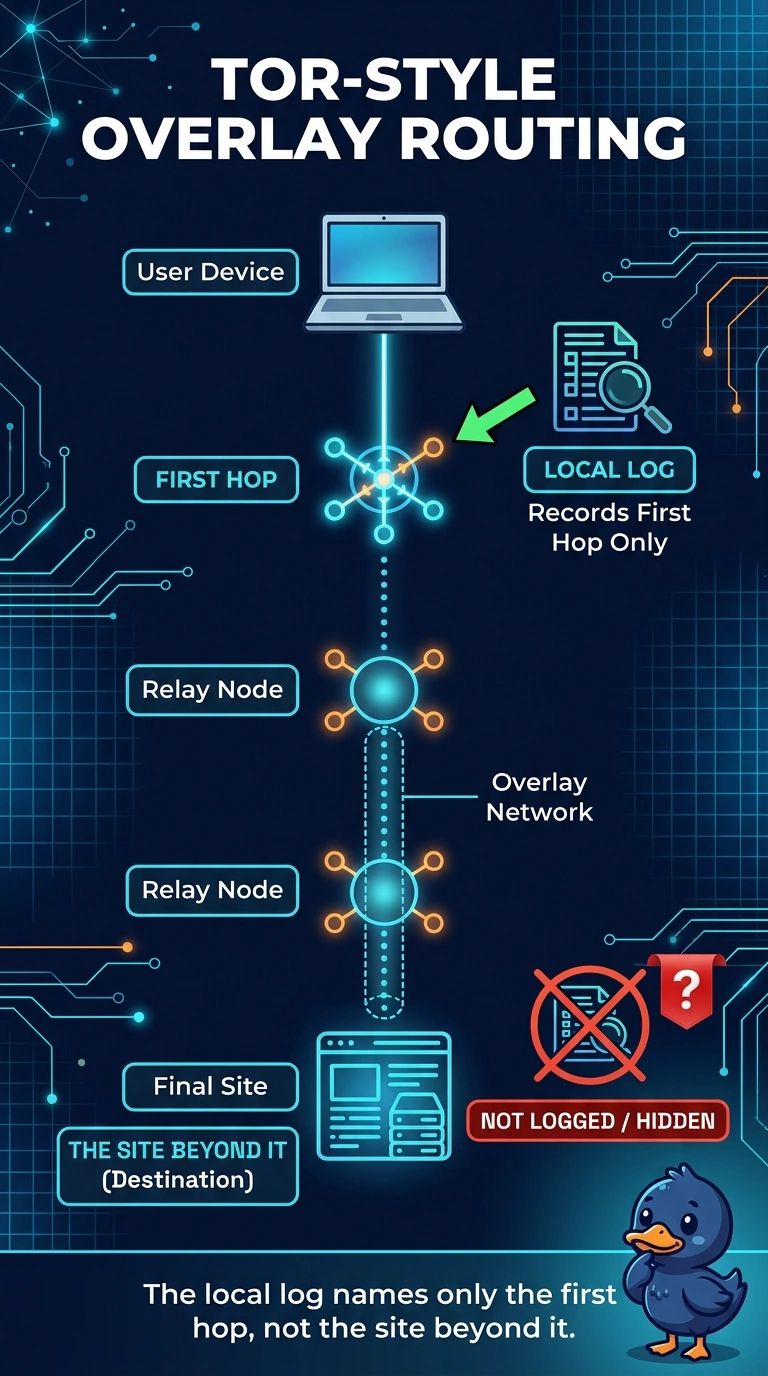
An agency workstation sends its web browsing into an anonymity overlay, and the local proxy log records only the first hop into that overlay. Which technology accounts for that limited record?
Select an answer to reveal the explanation.
Short Explanation
Picture a courier receipt that shows only the first handoff and leaves the final street off your copy. You see just the entry hop into the overlay, so that log cannot name the site beyond it. The trap is ordinary address translation that still logs the URL, a mail signature, or a VLAN tag.
Full Explanation
Tor-style overlay routing that lets the local log name only the first hop, not the site beyond it matches the agency log. Web traffic enters an anonymity overlay, and the local record stops at the entry into that overlay, so the address in the log is not the site the user reached. Treat that next hop as an entry, not as the destination page. Port address translation onto an on-site proxy that still logs each requested URL would still leave each requested URL in the on-site proxy log, which is the opposite of a record that ends at the first hop. An email signature block appended to outbound messages from the workstation account changes a footer on mail and does not select the path of a web request or hide the site that request was for. A VLAN tag added to Ethernet frames leaving the workstation access switch port marks a layer-2 segment on the access port and does not replace the destination a proxy would otherwise store. Exam caveat: describe the overlay's effect on the local log, and do not invent a relay count or a map of nodes. Operational check: read the proxy log's recorded next hop and confirm it is only the entry into the overlay before anyone treats that address as the site that was opened.