
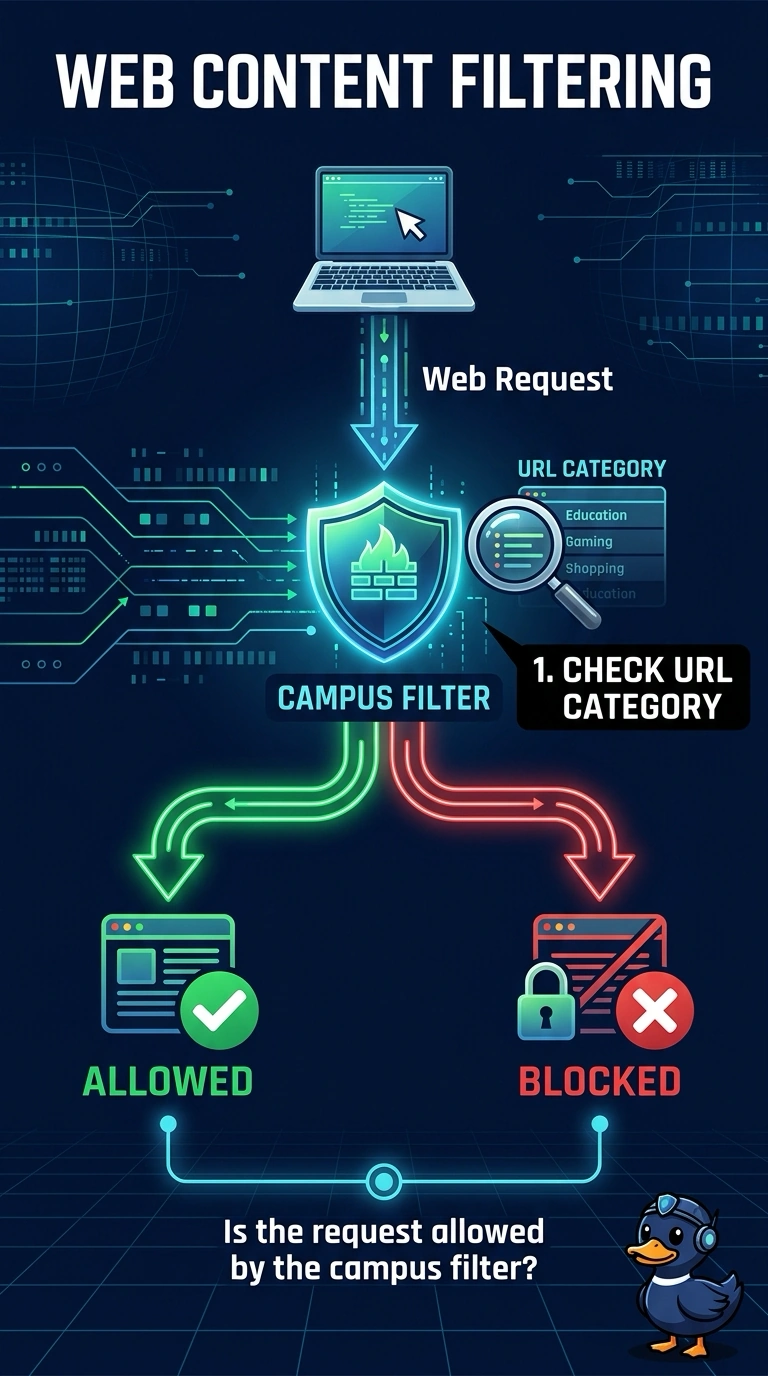
A university report lists a URL category and states whether the campus filter allowed the request. Which source produces a report in that form?
Select an answer to reveal the explanation.
Short Explanation
A library stamp tells you the shelf and whether the book was allowed to leave. A campus report with a URL category and an allow decision is web content filtering. Mail scoring, raw packets, and conversation byte counts do not assign that category.
Full Explanation
Web content filtering classifies a requested URL into a category and records whether the policy allowed or denied that request. A campus report that contains both the category and the decision is that control's output. Web content filtering that lists the URL category and whether the campus filter allowed the request. Mail inspection uses different objects. Email content filtering that scores a campus message together with each of its attachments judges a sender, a recipient, and files in a message, not a browser URL category. A capture keeps bits, not policy labels. A full packet capture of the request, storing the packets and assigning no URL category at all can be decoded later, but the report described already carries a category the capture itself did not assign. Flow counters are thinner. NetFlow byte counts for the same conversation, with no URL category and no allow decision can show that a conversation happened and how large it was, and they do not classify the URL. Exam caveat: content filtering is not one log. The exam splits web filtering from email filtering by the object in the record. A URL category plus an allow or deny is web filtering. Operational check: confirm the report fields are a URL category and an action, then confirm the same request is absent from the mail-filter log.