
A retailer stacks three identical firewalls in a row on the path to the internet, and every firewall allows the same outbound port that a known malware family uses. Which statement best explains why this is a weak reading of defense in depth?
Select an answer to reveal the explanation.
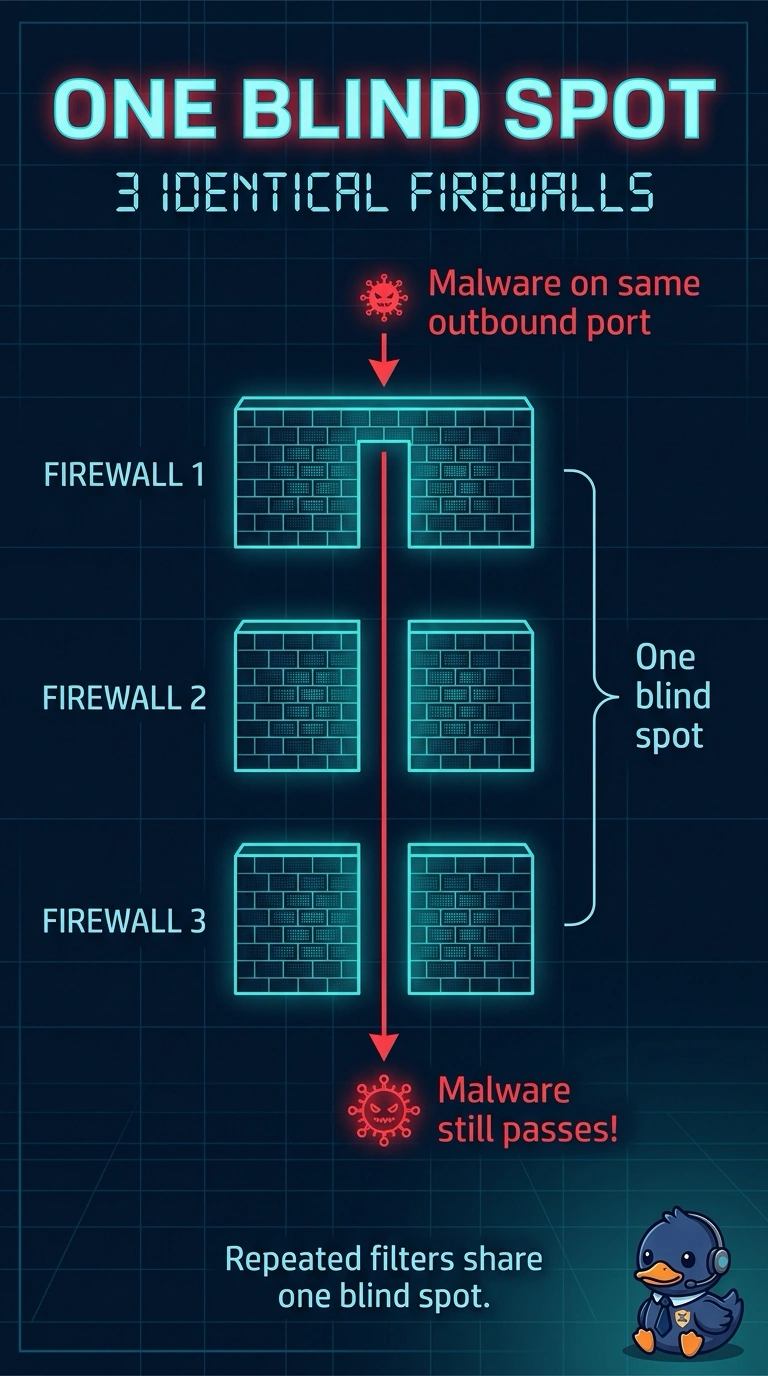
Short Explanation
Three identical padlocks on one gate still open with the same key. You have not built defense in depth when every firewall allows the same malware port. The trap is counting boxes and calling that pile a new control.
Full Explanation
The right selection is "Repeated copies of one filter share one blind spot, so the malware port all three allow still passes". Defense in depth is a series of different decisions, so a later control can stop what an earlier control of the same kind will miss. Identical allow rules never create that second decision, and the malware port stays open on every hop. The statement "Three matching firewalls already supply enough depth for any malware that uses this same outbound port" treats a repeated permit as if it were coverage, yet a port allowed on all three devices is still allowed. The statement "Defense in depth is defined by the appliance count, so three boxes on the path complete the design" swaps the principle for a headcount of appliances. The statement "Diversity does not matter when the firewall brand matches, so identical rules still count as depth" has the relationship backwards: matching brands and matching rules are how one blind spot becomes common to the whole row. Exam caveat: a further firewall adds depth only when its decision differs, such as denying a destination an earlier firewall permits. Operational check: place the three outbound policies side by side and mark whether that malware port is permitted on every device.