
A manufacturer alert names a process path and a registry run-key value on a single host. What do those two artifacts describe?
Select an answer to reveal the explanation.
Short Explanation
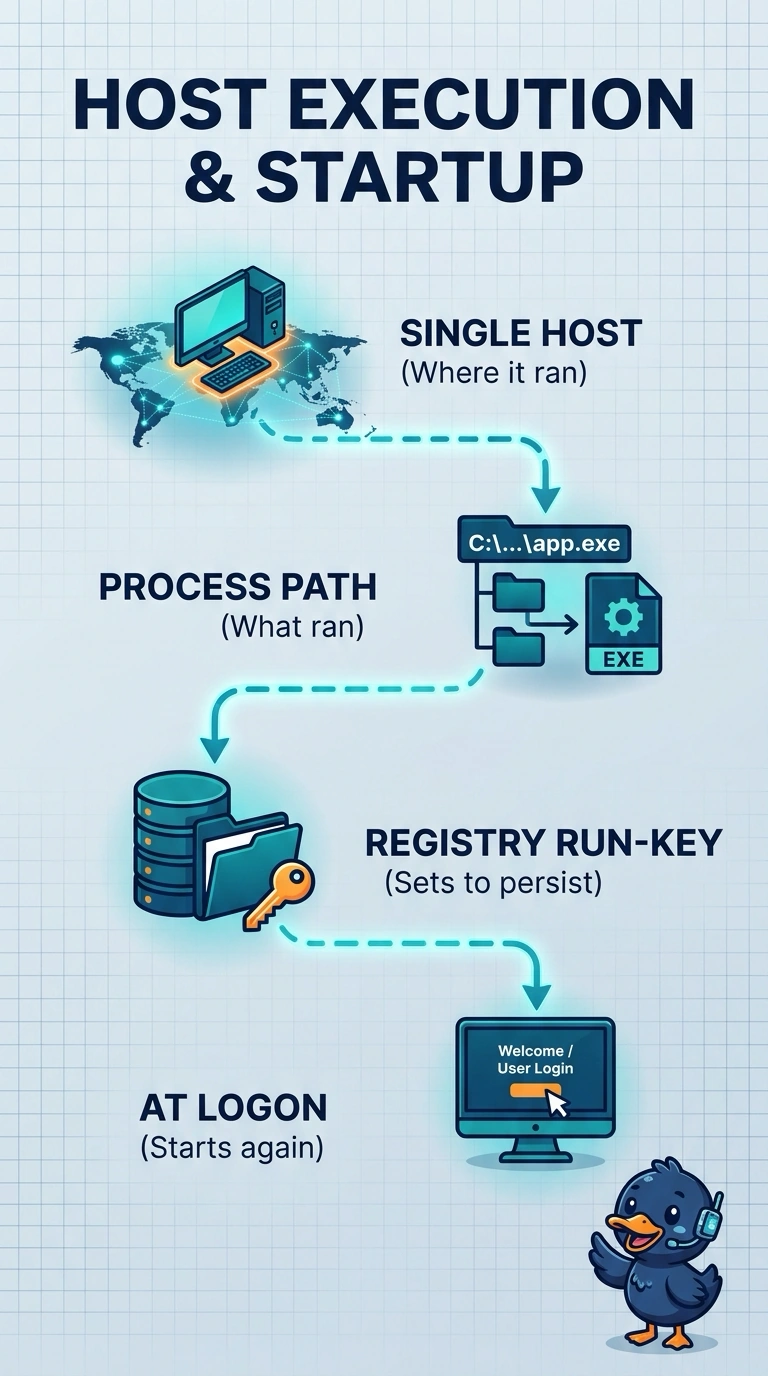
A process path tells you what walked in, and a run-key value tells you it left a key under the mat. Those two artifacts describe what ran on the host and how it is set to start again. The trap is answering with the cipher suite, the NAT mapping, or the mail gateway.
Full Explanation
The alert gives two host artifacts: a process path and a registry run-key value. The process path says what ran. A run-key value is an autostart entry that launches a program when a user logs on, which is how that program persists. Together they describe "What ran on the host and how that program is set to persist and start again at logon". A cipher suite is a TLS negotiation result. It is not a process or a run key, so "The cipher suite this host negotiated during its most recent TLS handshake with a peer" fails. A NAT mapping is an address translation at a firewall. It does not describe execution or persistence on the host, so "The network address translation mapping that rewrote this host address at the plant firewall" fails. The mail gateway is a delivery hop. It is not the process path or the run key on this host, so "The plant mail gateway that accepted the message used to deliver the sample to this host" fails. Exam caveat: a run key shows the autostart configuration for logon, and it does not by itself prove the process is running at the moment of the alert. Operational check: on the host, confirm the named process path and confirm the run-key value points at that program, then record both in the case notes.