
A bank SIEM search on one account shows repeated Windows 4625 events and then a single 4624 from an address that account has not used before. What does this sequence show?
Select an answer to reveal the explanation.
Short Explanation
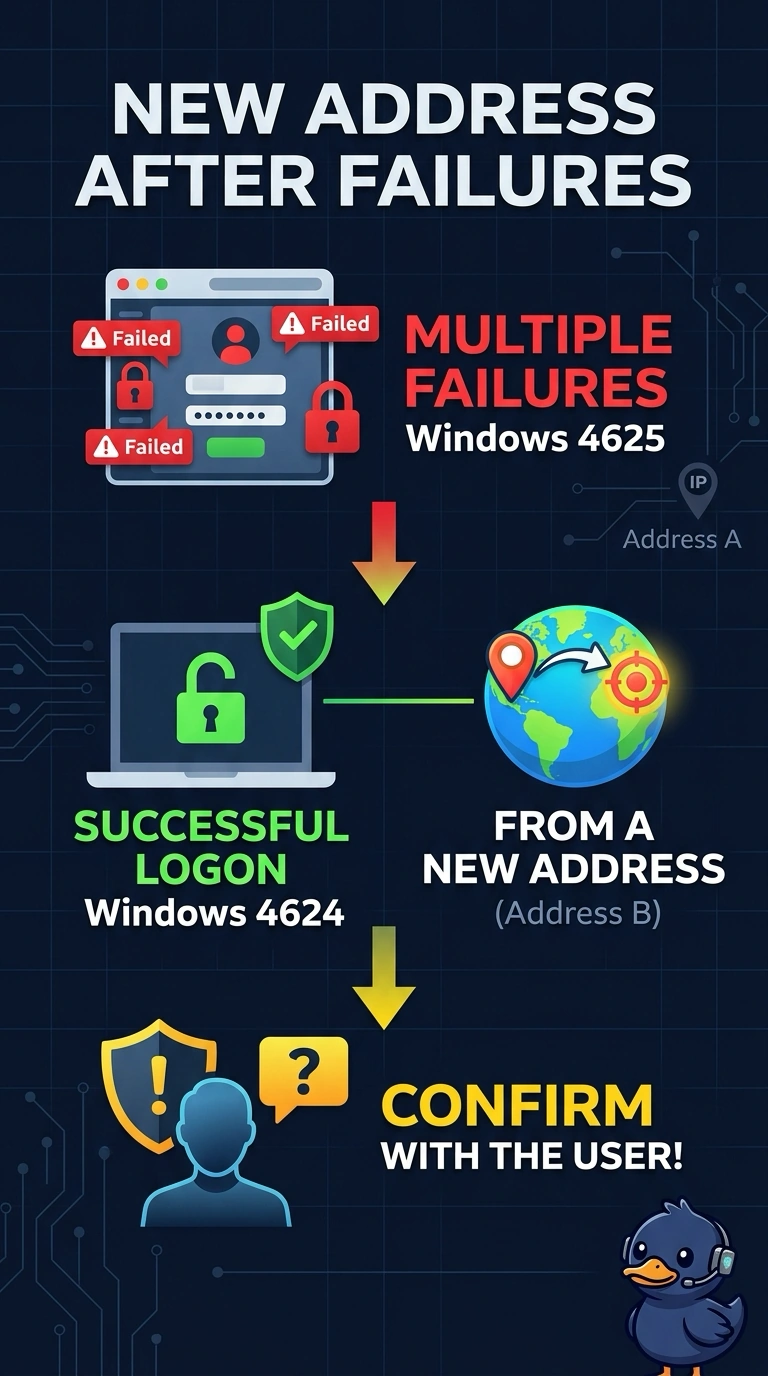
Wrong code, wrong code, then the door opens from a city you do not live in. You have a successful logon after failures, and you confirm it with the user. The trap is reading those events as a cleared audit log, a new service, or disk encryption.
Full Explanation
The right selection is "A successful logon after failures, from a new address, worth confirming with the user". Windows 4625 records a failed logon and 4624 records a successful logon. Repeated failures followed by one success from a new address is that pattern, and the success may be the account holder or someone else, so the user has to confirm it. The statement "Clearing of the security audit log, an action that removes this account's earlier history" would remove history, yet these records are present and they are logon events, so the log was not cleared. The statement "Installation of a new service on the bank workstation at the time of those account events" is a different host event from a logon success or failure, and the search did not show a service installation. The statement "Encryption of the workstation disk, with the logon events appearing only as a side effect" is not what 4624 or 4625 mean, and a logon from a new address does not describe disk encryption. Exam caveat: failures then a success are a lead, not proof of theft, which is why confirmation with the user comes before an intrusion claim. Operational check: ask the account holder whether they signed in from that new address, and compare the address with their known remote-access locations.