
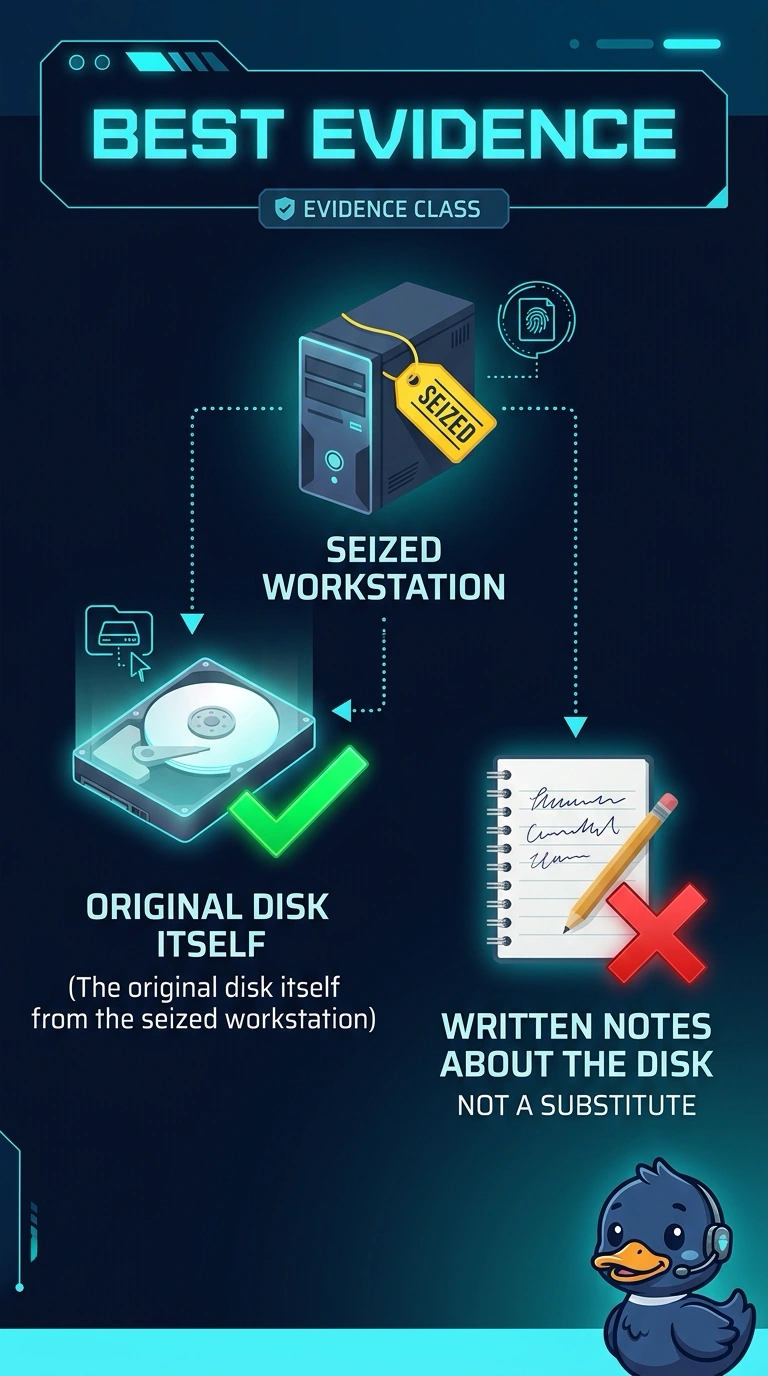
Counsel for an agency demands the original disk from a seized workstation and will not accept the analyst's written notes about that disk. What evidence class is the original disk?
Select an answer to reveal the explanation.
Short Explanation
The hearing wants the camera, not the reviewer's notebook. You classify the original disk as best evidence. The trap is giving the analyst notes the same evidence class as the disk.
Full Explanation
The right selection is "Best evidence, the original disk itself rather than a written description of what was on it". Best evidence is the original record. The disk is that record, and the notes are a description of it, so the notes cannot take the disk's class. The statement "Corroborative evidence, a second independent record that agrees with the analyst notes about the disk" would be a separate record that agrees with something else, and counsel refused the notes rather than asking for a second sensor. The statement "Indirect evidence, a suggestion about the disk that does not itself display the original contents" would suggest a fact without showing the original contents, and the disk is the contents. The statement "A SOC timing metric that records only how long the lab spent on the review of this seized disk" is a clock such as time to detect or time to contain, and a clock does not identify what kind of record the disk is. Exam caveat: analysts work from a copy so the original stays unchanged, and the copy does not replace the original when the request is for the disk itself. Operational check: confirm the evidence log names the original disk as the item counsel requested, with the notes listed only as analysis work product.