
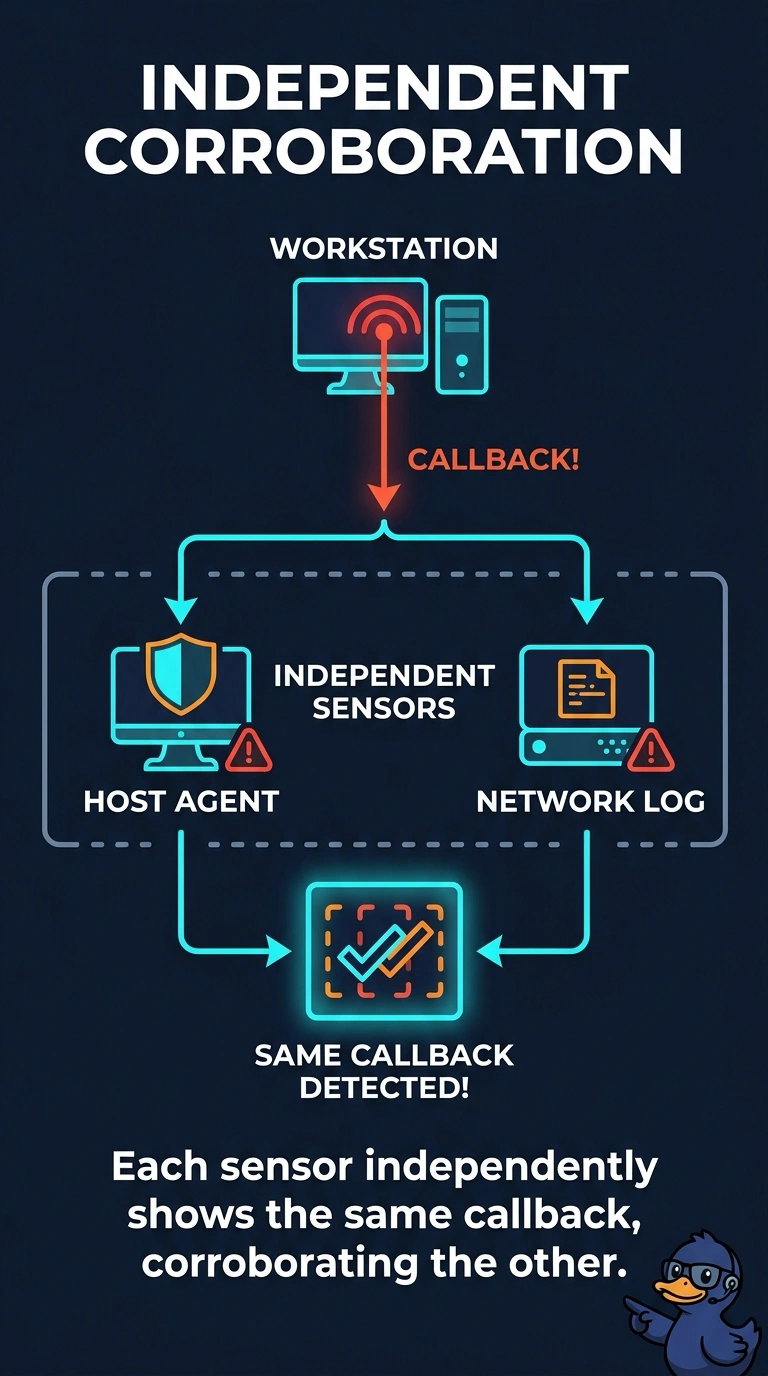
At a university, the host agent and the network log are independent sensors, and both show the same callback from one workstation. What is the relationship between those two records?
Select an answer to reveal the explanation.
Short Explanation
Two clocks that strike the same hour support each other. You should treat the host agent and the network log as corroborating each other when both show the same callback. The trap is thinking the second record erases the first, that two sensors make the proof merely indirect, or that neither original can still stand.
Full Explanation
Corroboration is agreement between independent sources. The host agent and the network log are separate sensors, and both show the same callback, so each one supports the other. The relationship is Each sensor corroborates the other by showing the same callback independently. Each sensor's original record can still be the best evidence of what that sensor observed. The network log destroys the host-agent record once both describe the callback reverses the relationship, because a second agreeing source does not erase the first. Both records are only indirect, merely from the fact that two sensors exist mislabels direct observations. Seeing the callback is not a mere suggestion, and having two sources does not weaken them into indirect evidence. Neither record can be best evidence once the other sensor also saw the callback confuses corroboration with a rule that originals stop counting. An original remains the best evidence of its own observation even when another sensor agrees. Exam caveat: corroborative evidence agrees with another source, and it does not demote both originals or turn a direct observation into a hint. Operational check: match the host, the time, and the callback address across the agent and the network log, and preserve each original rather than keeping only a merged summary.