
On an agency Linux jump host, a user's authorized_keys file gains a public key line that the account owner did not add. What access does that new line create?
Select an answer to reveal the explanation.
Short Explanation
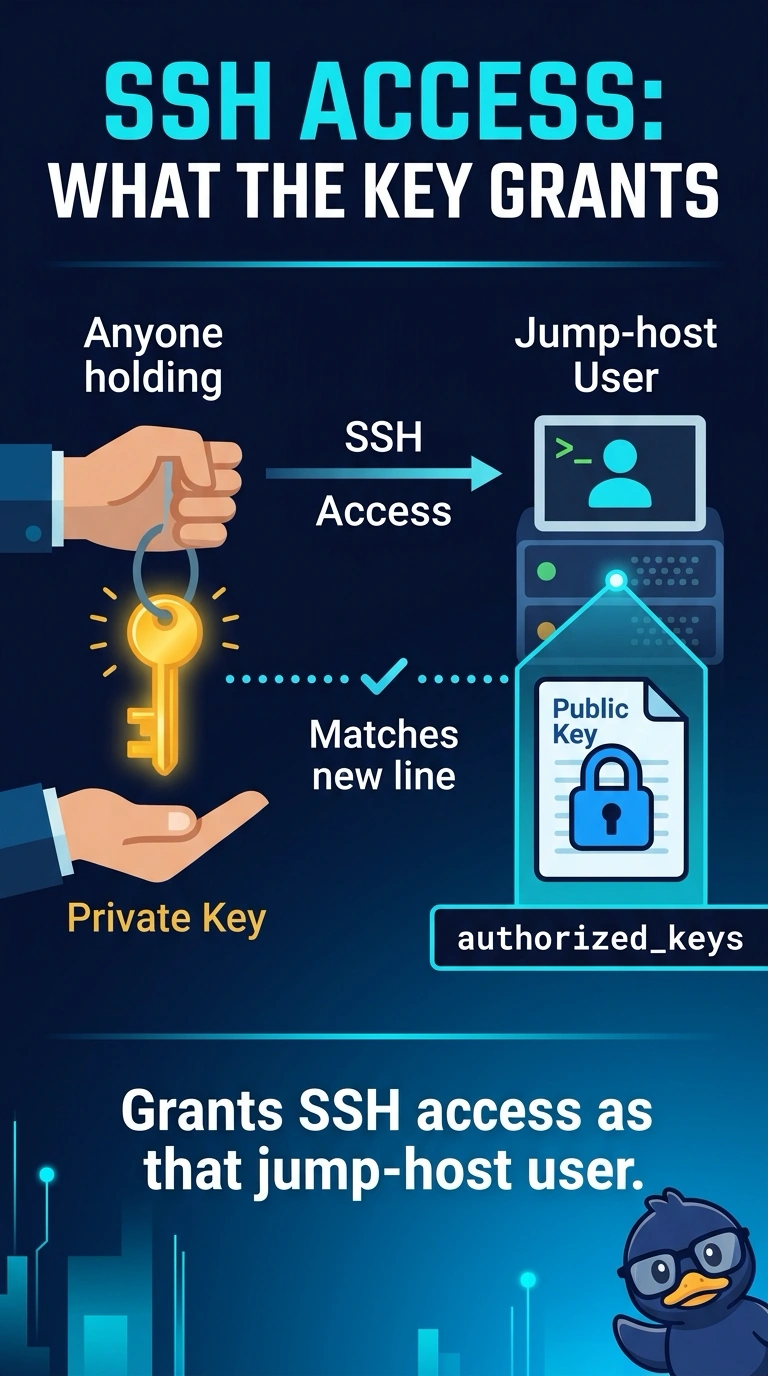
An extra house key lets in whoever holds the matching key to your door. A line someone else added to the jump host authorized_keys file allows SSH as that user. It does not install a Windows service, open a SQL injection, or write a firewall any-to-any rule.
Full Explanation
An authorized_keys line is a public key the SSH server will accept for that account. SSH access as that jump-host user for anyone holding the private key that matches the new line is the access the added line creates. A new Windows service installed on this Linux jump host by the extra public-key line is a Windows service concept, and a key line does not install one. A SQL injection path into an agency database, opened by the text of the added public key, would be a query flaw in an application, not a login key. A firewall rule that permits any source to any destination, written as a new line inside authorized_keys, misreads a key file as a packet filter; the file does not change firewall policy. Whoever holds the matching private key can open SSH as that user without knowing the account password. Exam caveat: the new line grants SSH as that user, not as every account on the jump host, unless the file belongs to a privileged account. Operational check: remove the unknown line, review the distribution authentication log for logins by that user, and rotate access if a login already occurred.