
On a hospital PC, Windows Security event 4688 records a new process after process-creation auditing was enabled so the event would exist. What does this event prove?
Select an answer to reveal the explanation.
Short Explanation
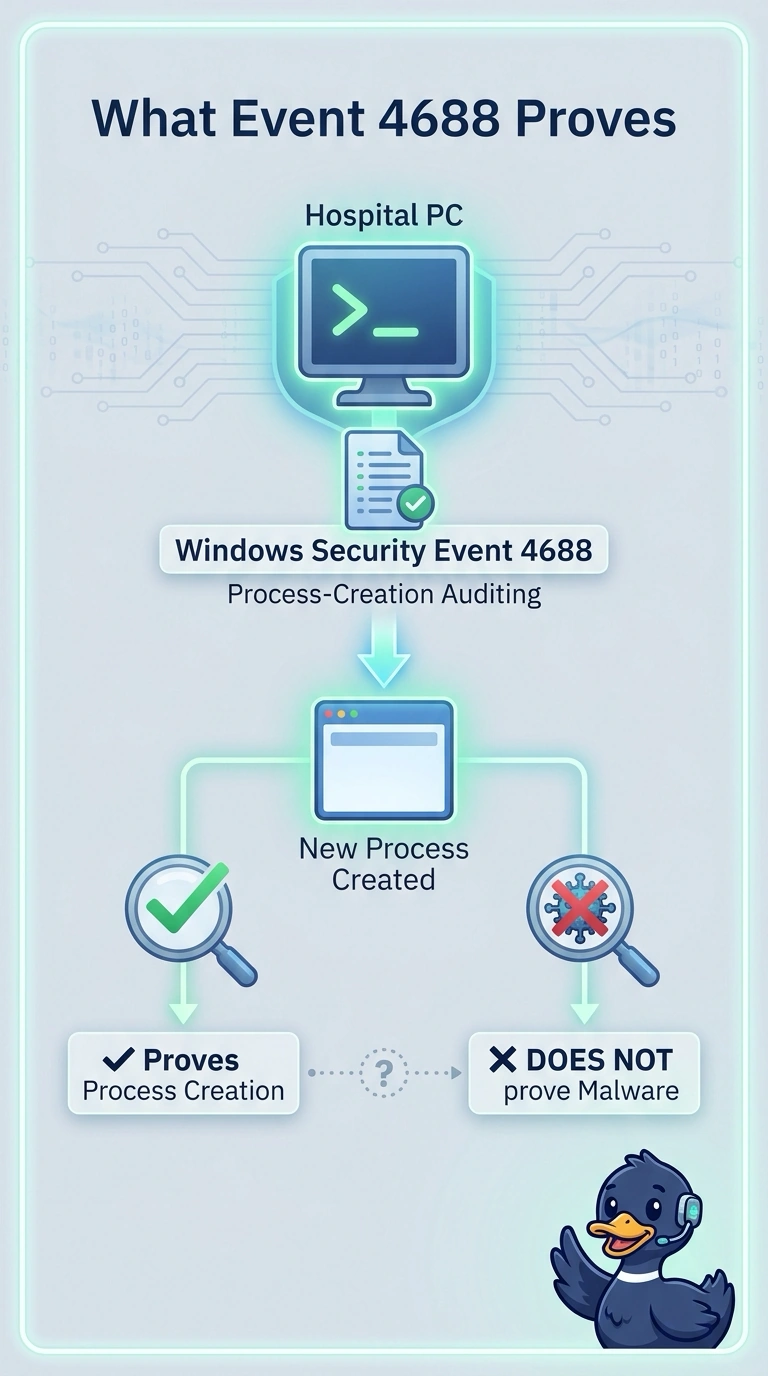
A birth record proves that a birth happened, not that a crime did. Event 4688 shows you a process was created on the hospital PC, not that the file is malware, and this event exists because the policy was enabled. It does not prove a finished connection, a deleted account, or a factory-default audit setting.
Full Explanation
Windows Security event 4688 is written when a new process is created, and only if process-creation auditing is enabled. The hospital turned that policy on, which is why the event is present. The event proves the process started. It does not classify the file. Proof a process was created on that host, without proving the executable file is malware. Reading a default into the event is the wrong lesson. Proof that process-creation auditing is already enabled by default on every new hospital PC is not what one 4688 establishes. This PC has the policy because someone enabled it. A host with the policy left off simply omits the event, so seeing the event is not evidence of a factory default. A later network session is a different fact. Proof the new process opened a successful connection to some remote network host is not contained in a process-creation record. Connection success has to come from another log. Account removal is a different audit event. Proof a user account was deleted from the local security database on that hospital PC would be event 4726, not 4688. Exam caveat: do not treat 4688 as proof the file is malicious, and do not treat its presence as proof that process-creation auditing is on by default. The stem already says the policy was enabled. Operational check: read the 4688 process name and parent, then look for a separate malware verdict before you call the file malicious.