
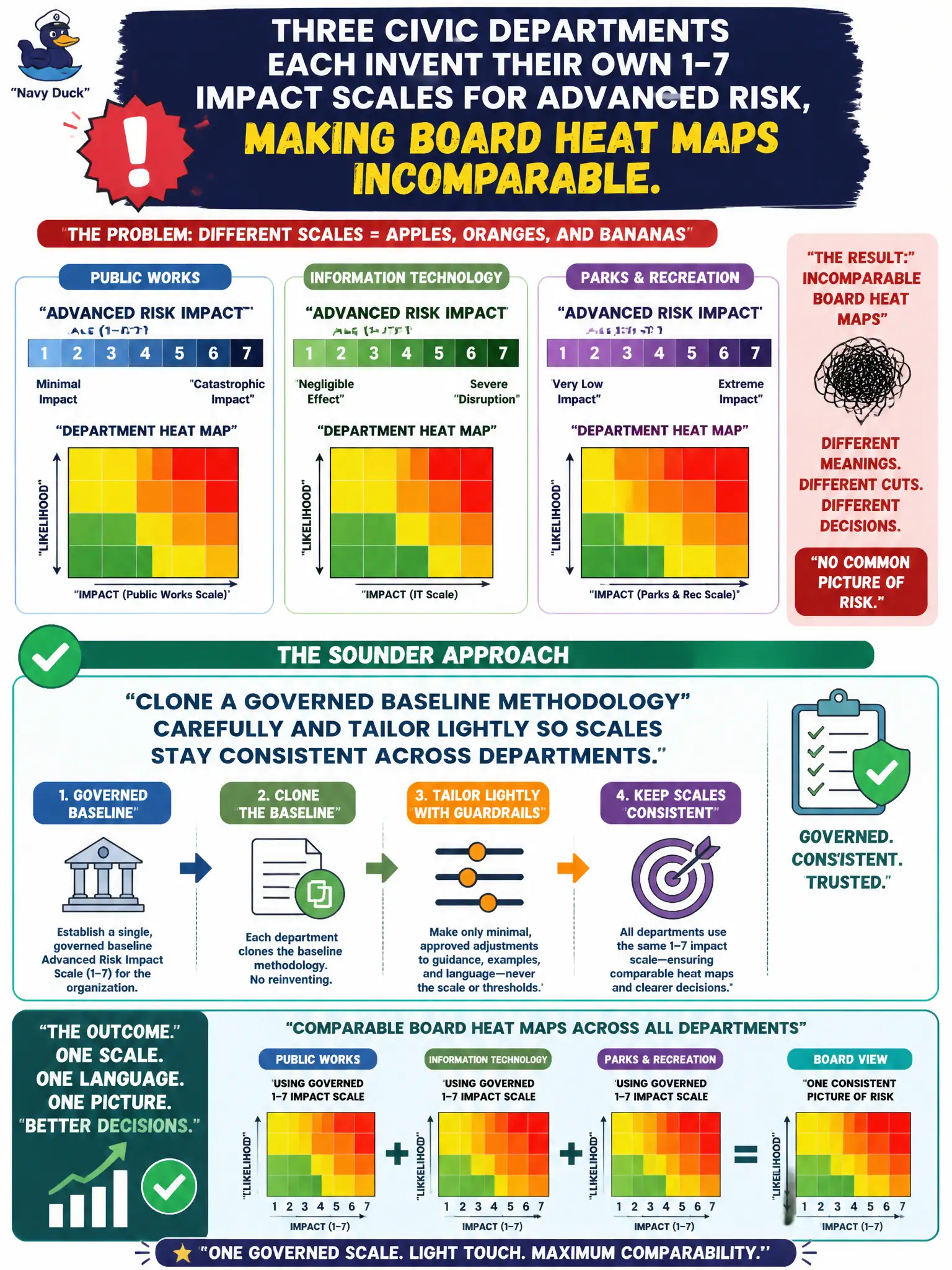
Three civic departments each invent their own 1–7 impact scales for Advanced Risk, making board heat maps incomparable. What is the sounder approach?
Select an answer to reveal the explanation.
Short Explanation
If every department brings a different yardstick, the heat map is modern art, not risk. Clone a governed methodology and tweak lightly so impact still means the same thing across the county. Wild unique scales or SIR severity cosplay break comparisons.
Full Explanation
When three civic departments invent incompatible 1–7 impact scales, board heat maps become incomparable. The sounder Advanced Risk approach is to clone a governed baseline methodology carefully and tailor lightly so scales stay consistent across departments. Shared methodology DNA preserves portfolio meaning while allowing minor local wording where justified.
Encouraging every team to invent unique scales maximizes creativity and destroys cross-department heat-map integrity. Disabling scoring entirely and reporting only open issue counts replaces residual posture with issue volume. Forcing all departments onto SIR severity codes as their only risk scale confuses incident severity with risk impact methodology.
Exam caveat: clone-and-tailor beats unique scales and SIR-severity cosplay. CIS-RC stresses comparable methodologies for executive views.
Operational check: publish a baseline methodology; clone for departments with minimal scale drift; sample two department assessments and confirm impact level meanings align on the county heat map.
Publish a county scoring style guide that defines what each impact level means in citizen-service terms, and require methodology clones to inherit those definitions. When departments request unique scales, route the request through GRC governance rather than allowing silent divergence that breaks board heat maps.