
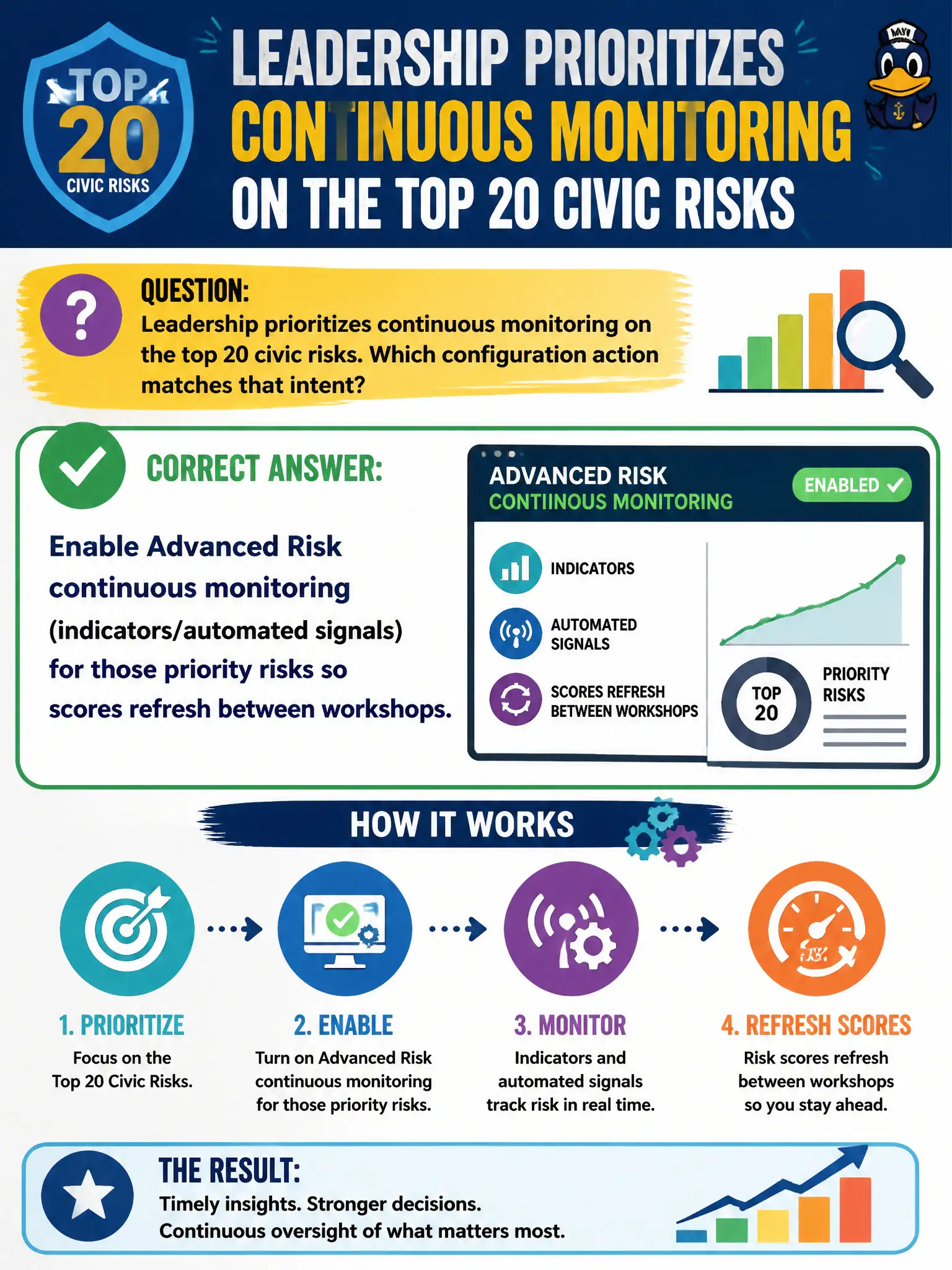
Leadership prioritizes continuous monitoring on the top 20 civic risks. Which configuration action matches that intent?
Select an answer to reveal the explanation.
Short Explanation
Continuous monitoring is the always-on watch on the risks that matter most. Flip it on for the top 20 so indicators keep residual posture fresh between the big workshops.
Full Explanation
Leadership priority on the top 20 civic risks is matched by enabling Advanced Risk continuous monitoring (indicators/automated signals) for those risks so scores and attention refresh between workshops. Continuous monitoring concentrates instrumentation where appetite and citizen impact are highest. That configuration intent is selective depth, not silence.
Exporting the top 20 to email and pausing IRM updates for a year abandons the platform as system of record. Converting the top 20 into audit engagements only mistakes third-line assurance for first-/second-line continuous monitoring. Removing all KRIs from priority risks to reduce noise deletes the very signals continuous monitoring needs—tune thresholds instead of deleting measures.
Exam caveat: priority risks deserve more monitoring, not less. Noise is a threshold problem; deletion is not the Advanced Risk answer.
Operational check: enable continuous monitoring on the documented top 20; attach at least one indicator each; verify refresh between workshop dates; if noisy, tune thresholds rather than removing KRIs.
Prioritize indicator coverage on the top 20 by citizen impact and residual band, then expand monitoring outward rather than instrumenting everything equally on day one. Continuous monitoring schedules and thresholds belong in the Advanced Risk configuration for those risks so workshop calendars no longer gate posture refresh. If leadership complains about noise, tune evaluation windows and thresholds; removing KRIs from priority risks contradicts the monitoring intent.