
A flood-loss estimate for a riverside plant is highly uncertain. What conceptual scoring mindset fits Advanced Risk–style quantitative thinking?
Select an answer to reveal the explanation.
Short Explanation
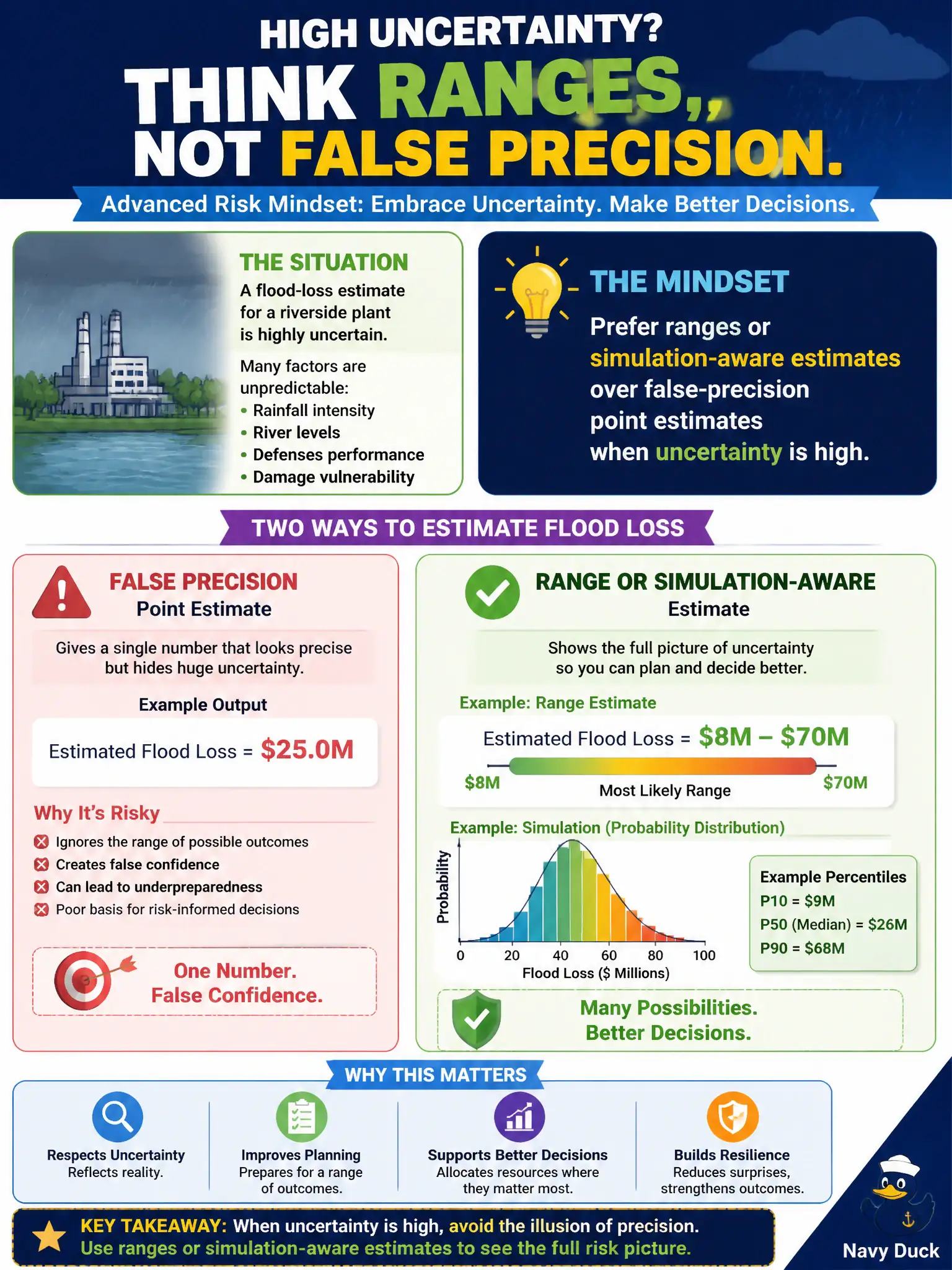
When the flood math is fuzzy, a fake-precise dollar to six places is theater. Ranges—or simulation-style thinking—beat pretending you know the exact loss. Guessing from slide count is not a model either.
Full Explanation
When a flood-loss estimate for a riverside plant is highly uncertain, Advanced Risk–style quantitative thinking prefers ranges or simulation-aware estimates over false-precision point estimates. Honest ranges better support civic capital and continuity decisions than fake precision. Publishing a single dollar figure with six decimal places to imply certainty fails by concept because spurious precision misleads leadership about uncertain flood loss. Refusing any numeric discussion and using only red/yellow/green forever fails by concept when quantitative insight is needed and uncertainty can be expressed as ranges. Replacing likelihood with the count of PowerPoint slides in the mitigation plan fails by concept because slide count is not a loss model. Exam caveat: CIS-RC quantitative mindset favors ranges under uncertainty rather than false point precision. Operational check: replace a single-point flood-loss figure with a documented range (or simulation summary), record assumptions and uncertainty, and present the range to the risk committee instead of a six-decimal point estimate. In civic IRM programs, retain configuration and decision evidence so examiners can reconstruct why this design supports public services.