
How should a CIS-RC implementer describe Advanced Risk relative to core risk capabilities?
Select an answer to reveal the explanation.
Short Explanation
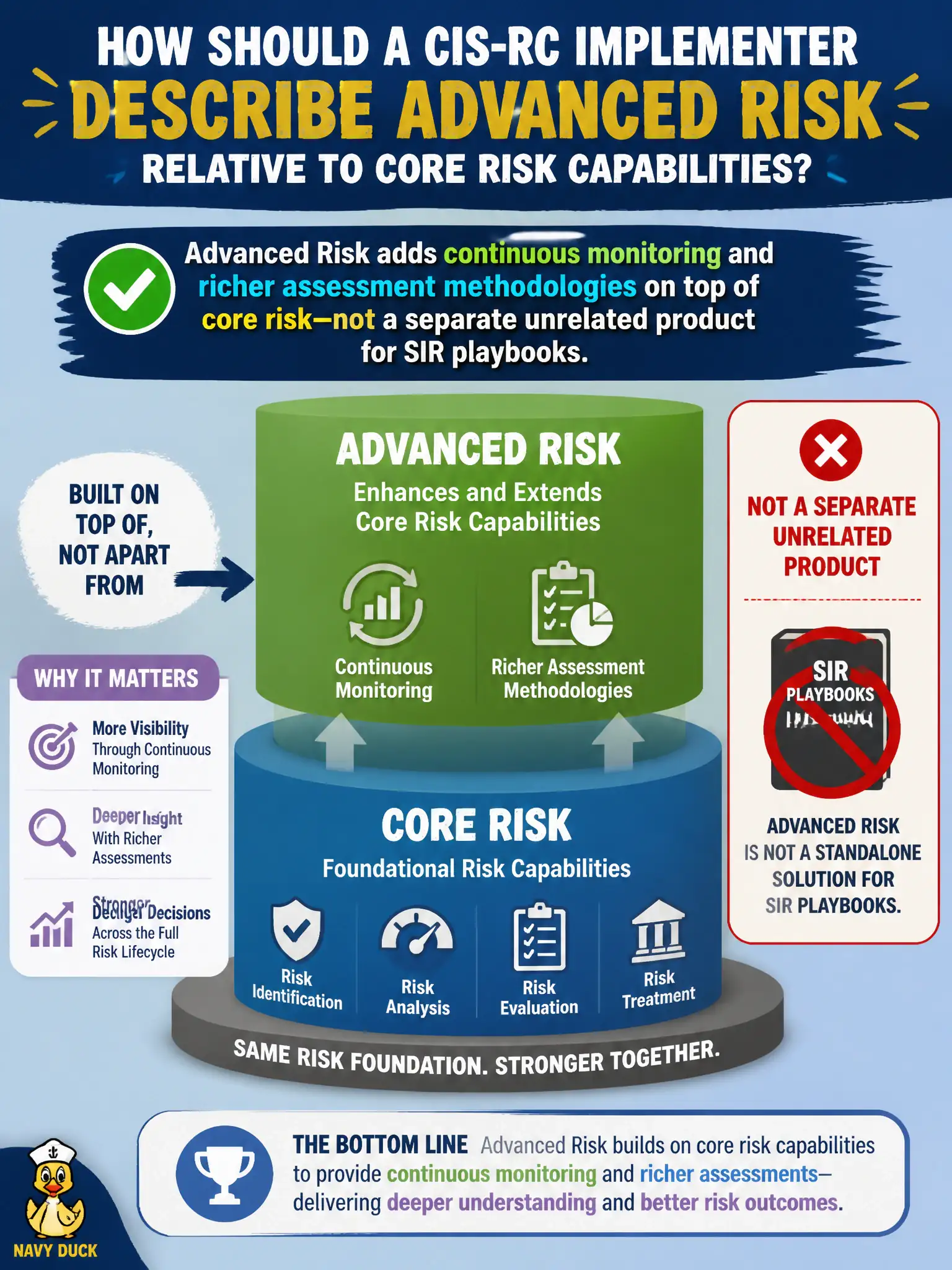
Core risk is the bicycle; Advanced Risk adds continuous monitoring and richer assessment gears on the same bike. It is not a new SIR playbook world and it does not rip out the entity framework.
Full Explanation
A CIS-RC implementer should describe Advanced Risk as adding continuous monitoring and richer assessment methodologies on top of core risk—not a separate unrelated product for SIR playbooks. Advanced Risk extends the same civic risk foundation rather than replacing it. Claiming Advanced Risk replaces the entity framework entirely fails by concept because entity scoping remains foundational. Claiming it is only a reporting skin with no assessment changes fails by concept because continuous monitoring and richer methods change how assessment operates. Claiming Advanced Risk is the CIS-SIR exam domain renamed fails by concept because Security Incident Response is a different product and exam focus. Exam caveat: CIS-RC positions Advanced Risk as an extension of core risk with monitoring and methodology depth. Operational check: inventory which continuous monitoring and assessment-methodology features are enabled under Advanced Risk, confirm core risk statements, entities, and treatments still operate, and document the extension model for stakeholders. In civic IRM programs, retain configuration and decision evidence so examiners can reconstruct why this design supports public services. In civic IRM programs, retain configuration and decision evidence so examiners can reconstruct why this design supports public services.