
What makes enterprise risk registers comparable across departments and applications in IRM?
Select an answer to reveal the explanation.
Short Explanation
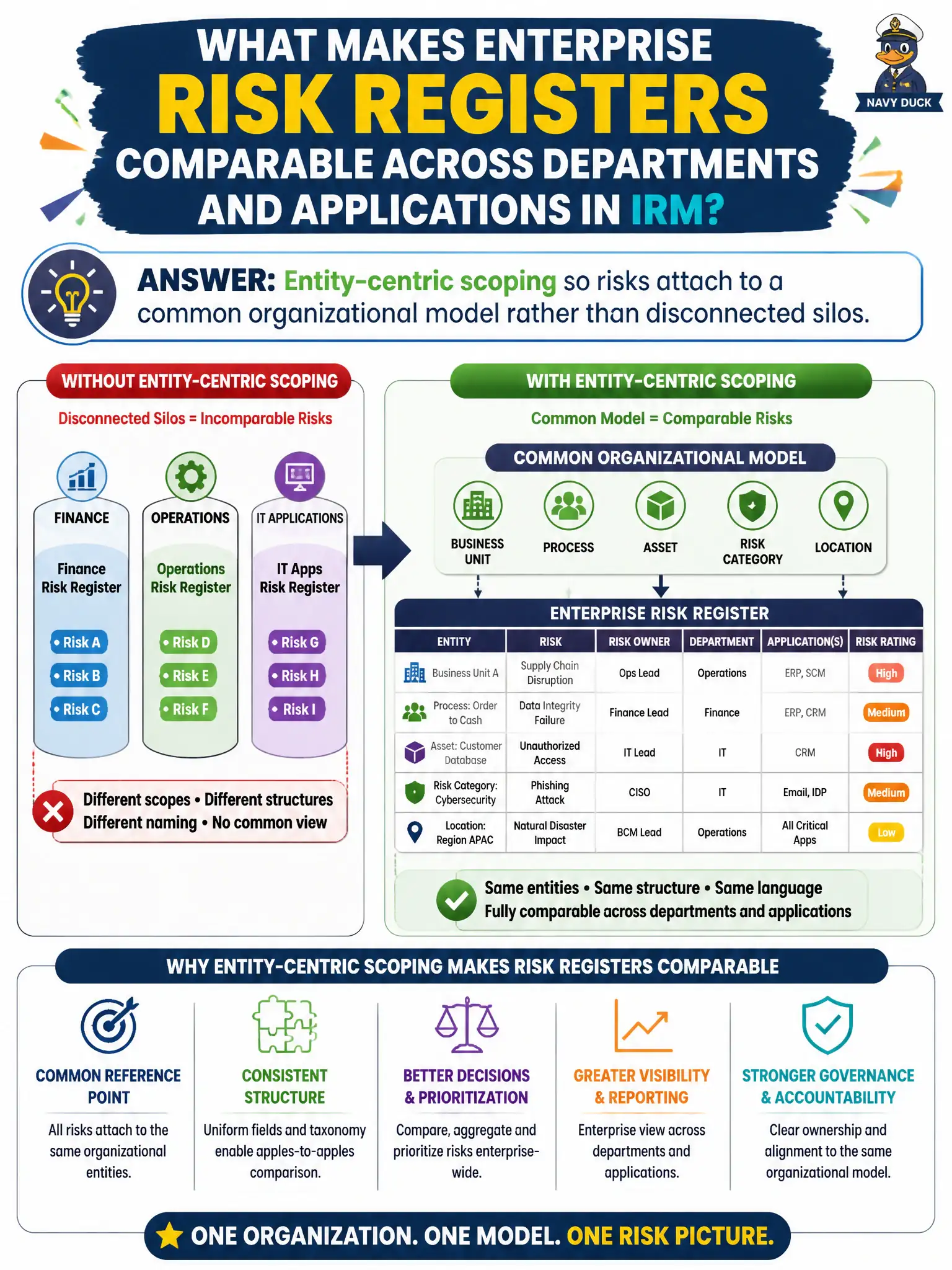
If every department invents its own island of risks, the enterprise map never lines up. Entity scoping—the shared org model—is what lets registers compare across apps and teams. Personal work notes and mystery scales kill comparability.
Full Explanation
Enterprise risk registers become comparable across departments and applications when risks use entity-centric scoping attached to a common organizational model rather than disconnected silos. Shared civic entities let city leadership compare apples to apples. Using unique custom score scales per team with no shared entities fails by concept because incomparable scales and silos prevent enterprise rollup. Storing risks only in personal work notes outside the platform fails by concept because personal notes are not an enterprise register. Removing all ownership fields to maximize anonymity fails by concept because anonymity destroys accountability and comparability of who owns what. Exam caveat: CIS-RC comparability depends on entity-centric scoping on a shared org model. Operational check: scope risks from two departments to entities in the same CMDB/org model, use the shared framework methodology, and produce a cross-department comparison report that aligns on entity and score fields. In civic IRM programs, retain configuration and decision evidence so examiners can reconstruct why this design supports public services. In civic IRM programs, retain configuration and decision evidence so examiners can reconstruct why this design supports public services.