
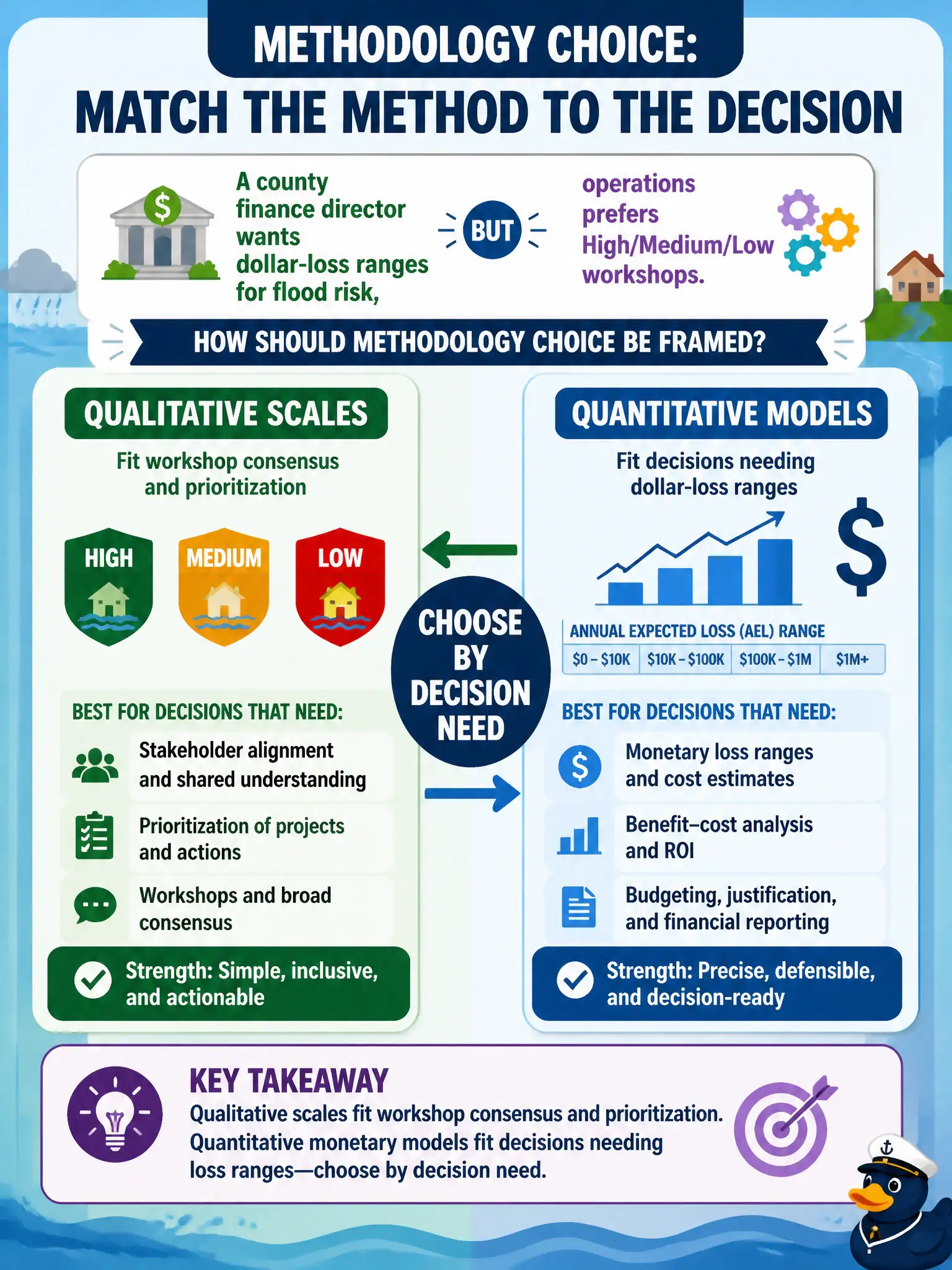
A county finance director wants dollar-loss ranges for flood risk, while operations prefers High/Medium/Low workshops. How should methodology choice be framed?
Select an answer to reveal the explanation.
Short Explanation
High/Medium/Low is fine when the room needs a shared language fast; dollar ranges matter when the budget fight needs numbers. Pick the method that matches the decision—not a religion that bans one or the other.
Full Explanation
Methodology choice should be framed by decision need: qualitative scales fit workshop consensus and prioritization; quantitative monetary models fit decisions needing loss ranges—choose accordingly for county flood risk. Finance’s dollar ranges and operations’ High/Medium/Low workshops can coexist when each serves its decision. Claiming quantitative models are illegal for municipal IRM fails by concept because public-sector IRM may use quantitative methods when appropriate. Declaring qualitative scales obsolete once any spreadsheet exists fails by concept because workshops still need shared ordinal language. Allowing only Monte Carlo outputs for elected officials fails by concept because not every board decision requires simulation. Exam caveat: CIS-RC selects qualitative versus quantitative methods based on decision need, not ideology. Operational check: for flood risk, run a qualitative workshop score for prioritization and, where budget decisions require it, add a documented monetary loss range; present both with clear purpose labels to leadership. In civic IRM programs, retain configuration and decision evidence so examiners can reconstruct why this design supports public services. In civic IRM programs, retain configuration and decision evidence so examiners can reconstruct why this design supports public services.