
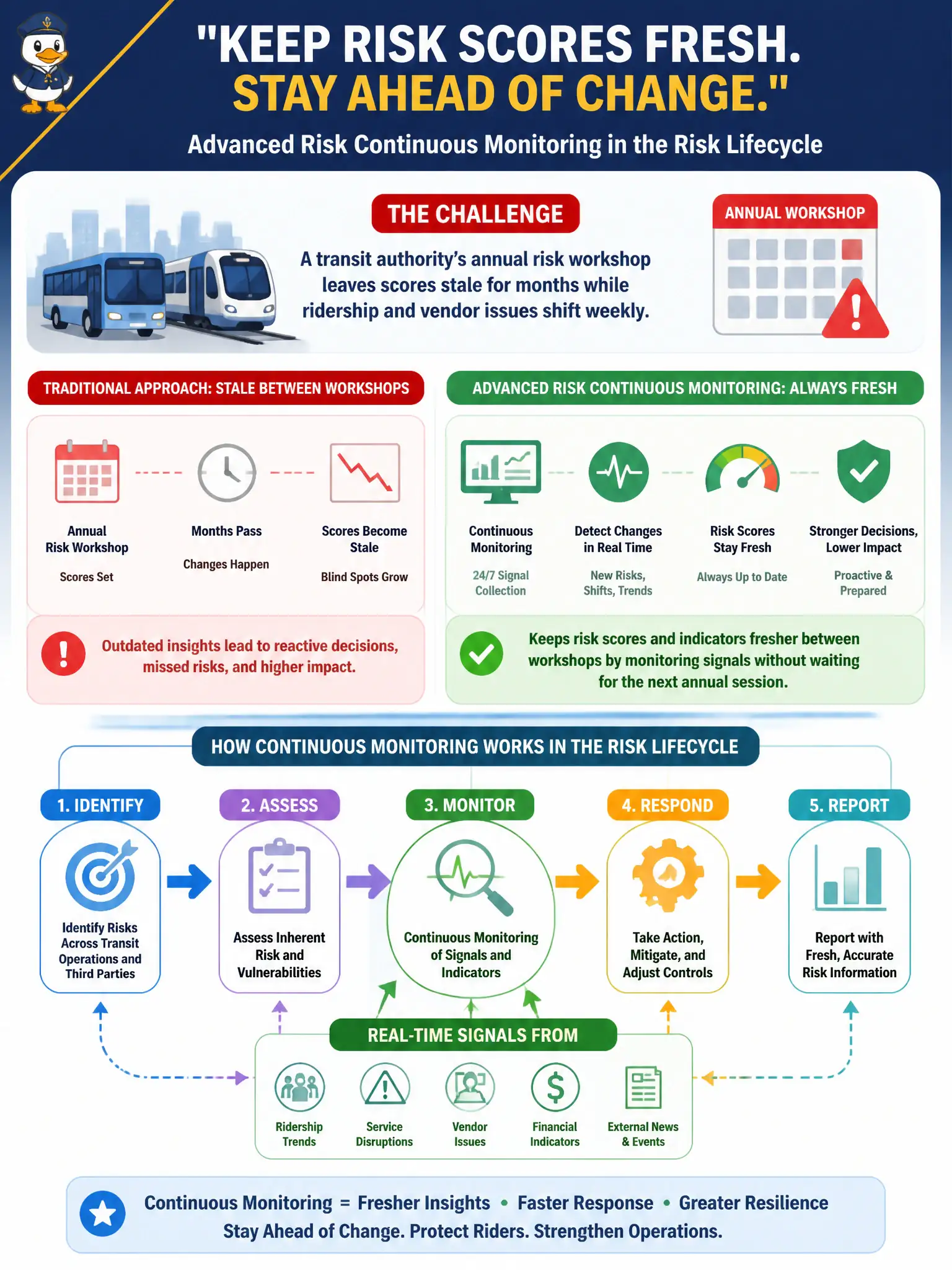
A transit authority’s annual risk workshop leaves scores stale for months while ridership and vendor issues shift weekly. How does Advanced Risk continuous monitoring help in the lifecycle?
Select an answer to reveal the explanation.
Short Explanation
Annual workshops are like checking the oil once a year on a city bus that runs all day. Continuous monitoring in Advanced Risk keeps scores and KRIs fresher between those big sessions so you are not flying blind for eleven months.
Full Explanation
Advanced Risk continuous monitoring helps a transit authority whose annual workshop scores go stale by keeping risk scores and indicators fresher between workshops—monitoring signals without waiting for the next annual session as ridership and vendor issues shift. Continuity matters for citizen mobility services that change weekly. Replacing entity scoping so risks no longer need an owning organization fails by concept because continuous monitoring does not abolish entity ownership. Archiving all residual scores nightly so only inherent remains fails by concept because discarding residual each night destroys monitored posture. Converting every qualitative risk into a mandatory Monte Carlo model overnight fails by concept because continuous monitoring is not forced universal quantification. Exam caveat: CIS-RC Advanced Risk continuous monitoring refreshes signals between formal assessments without removing core scoping. Operational check: enable indicators or continuous monitoring on priority transit risks, verify scores or risk posture update between workshop dates when signals breach, and confirm entity ownership remains intact. In civic IRM programs, retain configuration and decision evidence so examiners can reconstruct why this design supports public services.