
A county clerk’s office needs to show SOX-like financial control testing for a shared-services ERP. Which use-case framing best fits IRM?
Select an answer to reveal the explanation.
Short Explanation
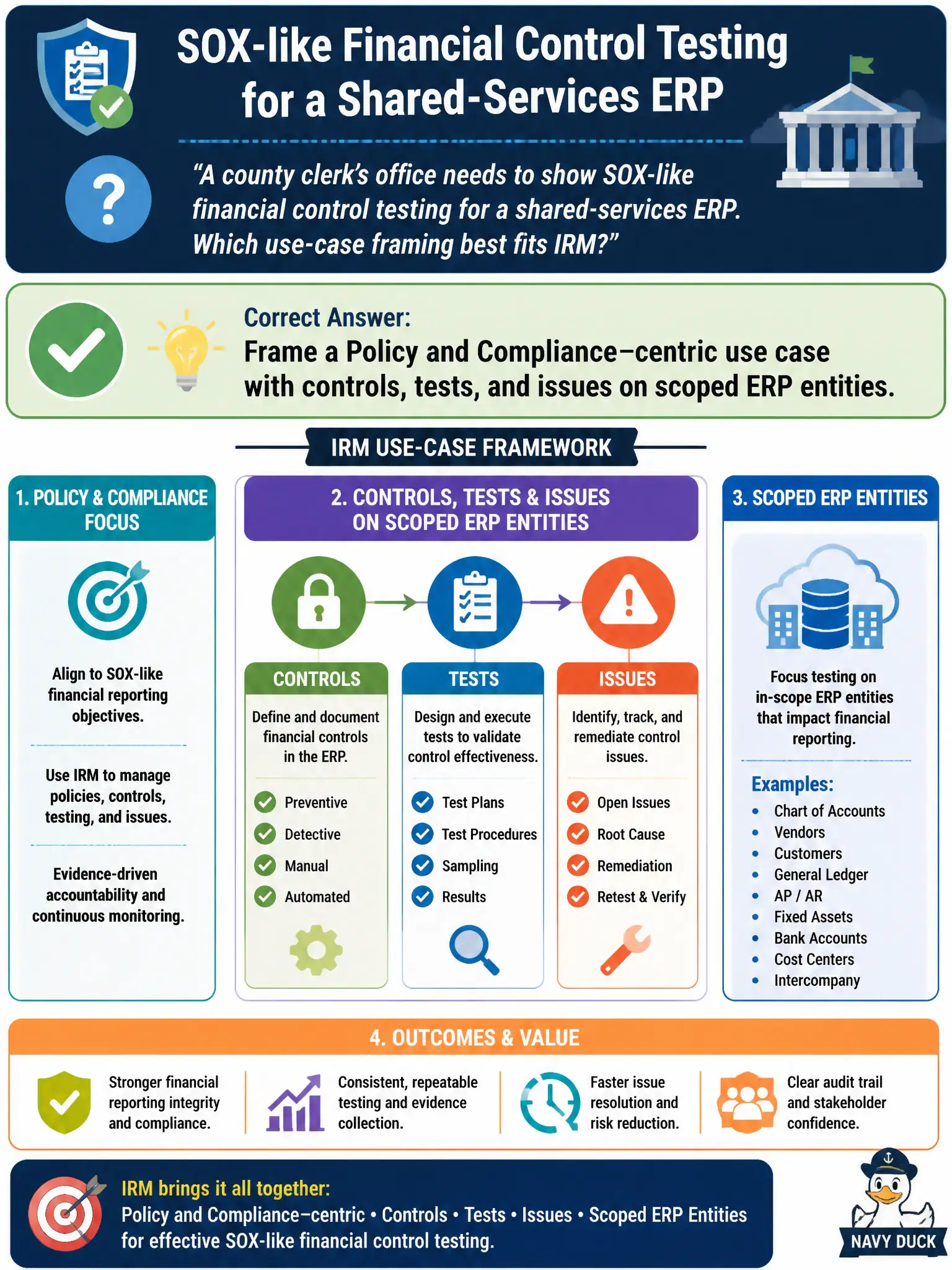
Financial control testing is classic Policy and Compliance territory—map the obligations, put controls on the ERP entities, run tests and track issues. SIR playbooks and SAM licenses solve different problems. Match the use case to the IRM app that actually owns compliance testing.
Full Explanation
SOX-like financial control testing for a shared-services ERP fits a Policy and Compliance–centric use case with controls, tests, and issues on scoped ERP entities. The county clerk’s office needs mapped obligations, entity-scoped controls, repeatable testing, and remediation tracking—the IRM path that owns compliance testing. Framing the need as SIR playbooks, SAM entitlements, or major-incident bridges misaligns the business outcome to the wrong product. Leading with Security Incident Response playbooks as the primary control-testing system confuses breach response with financial control assurance. Treating the need as pure Software Asset Management entitlement reconciliation answers licensing, not control operating effectiveness. Routing all financial control evidence only through ITSM major-incident bridges leaves no standing compliance testing model. Exam caveat: match the use case to the IRM application that owns the outcome—here Policy and Compliance testing. Operational check for the clerk’s office: identify ERP-related entities, map a small set of financial control objectives, generate controls, run one test cycle with issues tracked in IRM, and show sponsors evidence without opening SIR or SAM as the system of record.