
A stakeholder asks what scoping means in ServiceNow GRC/IRM. Which explanation is correct?
Select an answer to reveal the explanation.
Short Explanation
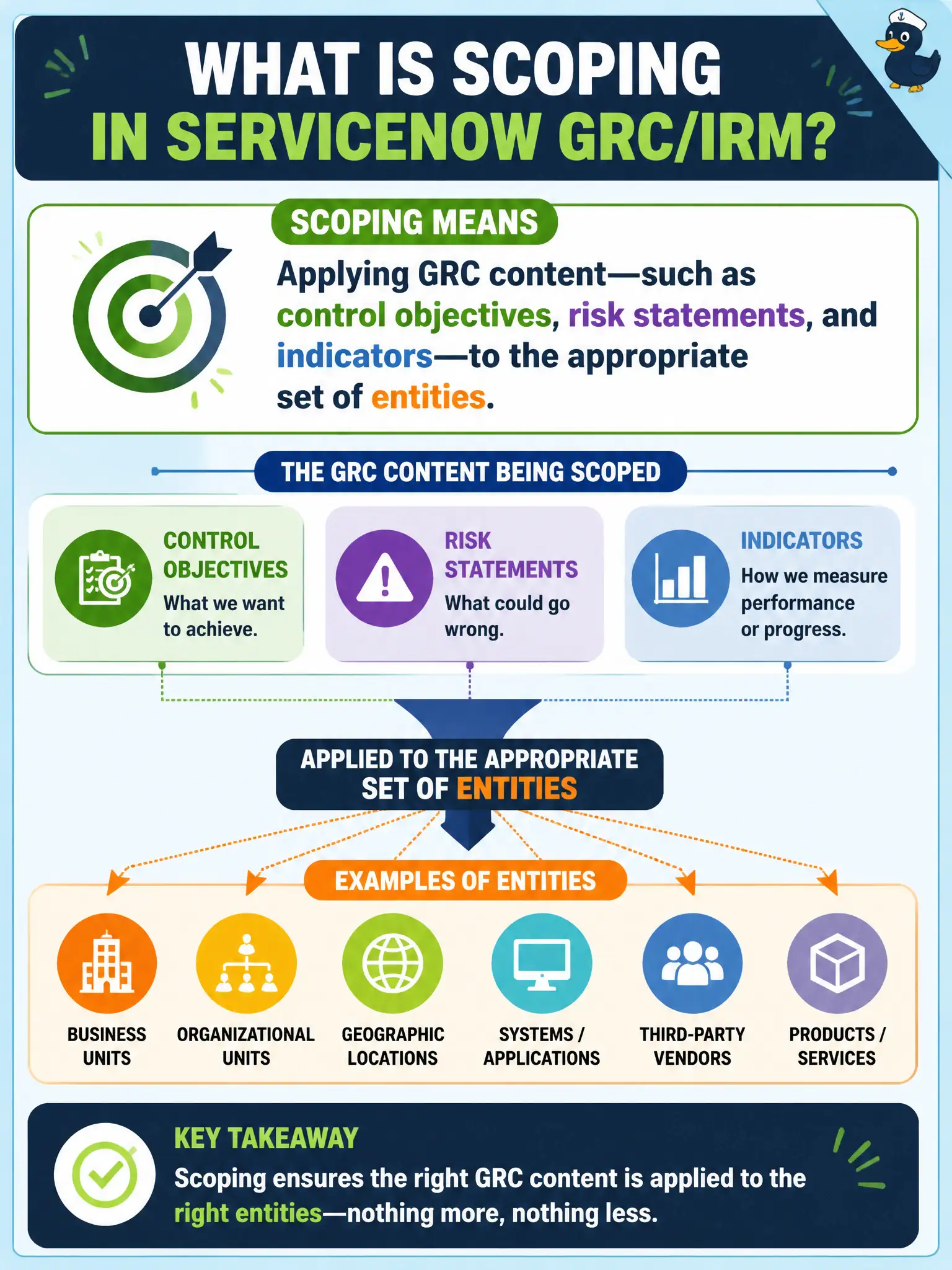
Scoping is hanging the right picture on the right wall. You take objectives, statements, and indicators and attach them to the entities that actually need them.
Full Explanation
Scoping in ServiceNow GRC/IRM means applying GRC content—such as control objectives, risk statements, and indicators—to the appropriate set of entities. It is hanging the right picture on the right wall so assessments, tests, and monitoring run against real organizational objects rather than floating library text. Without scoping, civic programs cannot prove which departments, applications, or facilities an obligation covers, and automation has nothing coherent to target. Scoping is therefore the binding step that turns reusable content into operational work items on a population. Defining scoping as deleting unused ITSM catalogs before go-live confuses service-catalog cleanup with GRC association. Defining scoping as assigning Pearson VUE seats invents exam-logistics noise unrelated to Risk and Compliance. Limiting scoping to firewall log retention only shrinks a framework concept into a narrow SOC setting. Exam caveat: scoping is the binding of content to entities across policy, risk, and monitoring—not ITSM hygiene or exam administration. Operational check for the stakeholder: take one control objective and one risk statement, associate them to a defined entity population, generate or verify items, and report which entities are in and out of that content’s scope for leadership sign-off.